 Wikimedia Commons
Mature Harappan phase — c. 2600–1900 BCEArchaeological ComplexUNESCO World HeritageMythology
Mohenjo-daro — The Mound of the DeadIndus Valley Civilization Mythology
The largest known city of the Indus Valley Civilization — gridded streets, baked-brick sewers, a great ceremonial bath, and a script that has resisted decipherment for a century.
Cultural sensitivity notice
The Indus script is undeciphered. Mythic Grounds does not assign religious or cultural-symbolic meanings to Indus artifacts beyond what the archaeological record supports. Modern South Asian religious traditions postdate the Indus civilization and should not be retrojected onto it.
The Myth
Mohenjo-daro presents the rare and instructive case of a great ancient city about whose mythology we genuinely do not know. The Indus script — thousands of short inscriptions catalogued across all Indus sites, most fewer than five signs and the longest under thirty — remains undeciphered. The figurines, seals, and tablets recovered from the site (the so-called "Priest-King" bust, the dancing-girl bronze, the "Pashupati" seal showing a cross-legged horned figure surrounded by animals) have been interpreted as everything from proto-Hindu antecedents to administrative tokens. The honest reading is that we don't know.
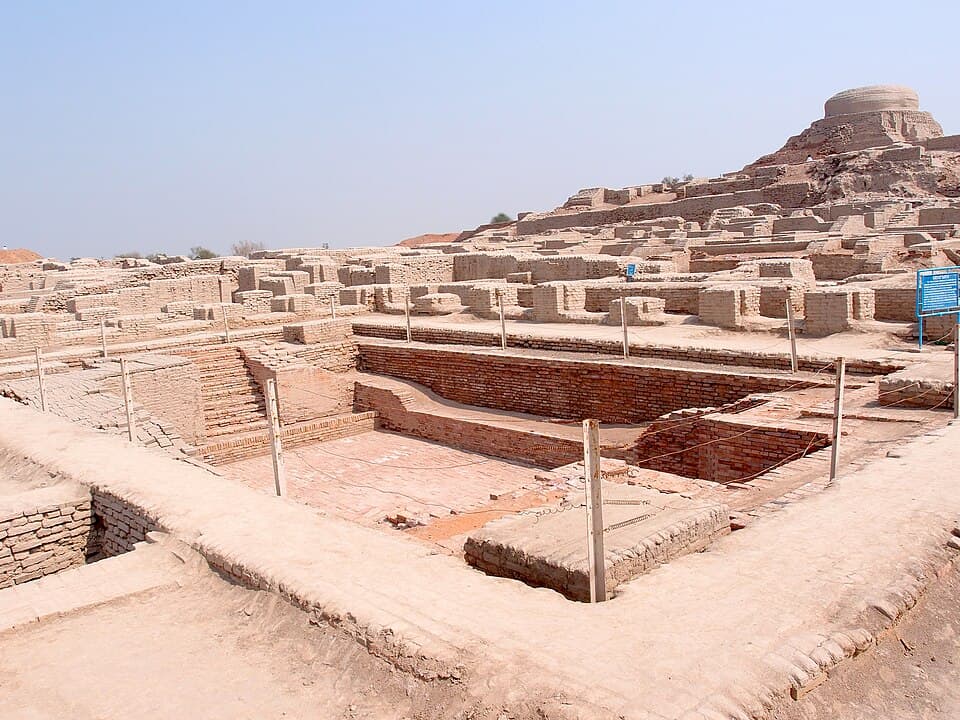
What the material record does suggest is a civilization in which water and bathing played an unusually central role. The Great Bath — a watertight brick tank on the citadel mound, lined with bitumen — was almost certainly a ceremonial structure rather than a swimming pool, and the residential quarters of the city contain an unusual density of private bathing rooms and wells. Some scholars have read this as a Bronze Age precedent for the South Asian preoccupation with ritual purification, but the link across the intervening fifteen hundred years is suggestive, not proven.
Mythic Grounds publishes Mohenjo-daro under an archaeological lens because the responsible thing to do, given the absence of decipherable texts, is to refuse the temptation to project later Indic religion backward onto the Indus. The site's significance is real and large; the stories told about it should be tied to what the trowel has actually found.
Want more like this?
The Weekly Myth hasn't started yet: one sacred site a week, its myth and its history. Leave your email and we'll write when the first one goes out.
We'll only use your email for the Weekly Myth. Unsubscribe anytime.
Themes
The Place
Mohenjo-daro lies in the Larkana District of Sindh province, in the Indus River floodplain about 28 kilometers from the modern town of Larkana. The site covers roughly 300 hectares (about 460 acres) and is organized into two distinct mounds: the lower city to the east, with the residential and craft quarters laid out on a strict grid, and the citadel mound to the west, raised on a massive mudbrick platform and bearing the Great Bath, the so-called Granary, and the Pillared Hall.
The streets of the lower city run north-south and east-west, divided into blocks of roughly equal size. Almost every house has a private well and a bathing room, and wastewater drains through covered terracotta-brick sewers running beneath the streets — among the earliest known municipal sanitation systems anywhere in the world. The houses are built of standardized baked brick (ratio 1:2:4), and the larger ones rise to two stories.
The Great Bath measures roughly 12 by 7 meters and is 2.4 meters deep. Its floor and walls are lined with bitumen for waterproofing — the earliest known use of bitumen as a structural sealant. A nearby well fed it. Surrounding the bath are colonnaded galleries and what may have been small private bathing cells.
The site is now severely threatened by salinization from rising groundwater. UNESCO and the Pakistani government have undertaken stabilization work since the 1970s.
The History
Mohenjo-daro was occupied from approximately 2600 BCE to 1900 BCE, the apogee of the Mature Harappan phase of the Indus Valley Civilization. At its peak it housed an estimated 30,000 to 40,000 inhabitants — placing it on a scale broadly comparable to contemporary Mesopotamian Ur or the population centres of Old Kingdom Egypt.
The site was identified in 1922 by R. D. Banerji of the Archaeological Survey of India. Sir John Marshall, then director of the ASI, oversaw the principal excavation seasons through the 1920s; his three-volume Mohenjo-Daro and the Indus Civilization (1931) is the foundational synthesis, drawing together the 1922–1927 seasons. Subsequent work at the site was carried out by Ernest Mackay (1927–31, with later excavations at Chanhu-daro), Mortimer Wheeler (1950), and George Dales (1964–65). Since 1966, most excavation has been paused in favor of conservation as the site is highly vulnerable to salt damage from rising groundwater.
Dating relies on stratigraphy correlated with radiocarbon samples from organic material in occupation levels, cross-checked against parallel Indus sites such as Harappa, Dholavira, and Lothal. The Indus script has been studied since the late 19th century and remains undeciphered; competing decipherment claims appear in the literature but none has achieved scholarly consensus. The civilization's gradual decline between roughly 1900 and 1300 BCE is now most commonly attributed to a combination of weakening monsoon patterns, shifting and drying river courses (particularly the Ghaggar-Hakra system), and the resulting strain on urban food supplies.
Mohenjo-daro was inscribed as a UNESCO World Heritage Site in 1980.
Frequently Asked
The largest known Indus Valley city — gridded streets, baked-brick sewers, a Great Bath, and a script that has resisted every attempt at decipherment for a century.
Sources
Marshall, Sir John (ed.). Mohenjo-Daro and the Indus Civilization (3 vols) (1931). Arthur Probsthain, London. Foundational synthesis of the 1922–1927 ASI excavation seasons. The single most cited work on the site.
Tier 1Possehl, Gregory L.. The Indus Civilization: A Contemporary Perspective (2002). AltaMira Press. Authoritative modern synthesis of seven decades of Indus archaeology.
Tier 2Kenoyer, Jonathan Mark. Ancient Cities of the Indus Valley Civilization (1998). Oxford University Press. Standard reference on Indus urbanism, with extensive treatment of Mohenjo-daro's layout and material culture.
Tier 2UNESCO World Heritage Centre. Archaeological Ruins at Moenjodaro — Inscription Documentation (1980). UNESCO. View source → Official UNESCO World Heritage listing and management documentation.
Tier 3Petrie, Cameron A., R.N. Singh, J. Bates, et al.. Adaptation to Variable Environments, Resilience to Climate Change: Investigating Land, Water and Settlement in Indus Northwest India (2017). Current Anthropology, Vol. 58, No. 1 (DOI 10.1086/690112). View source → Flagship TwoRains output reframing 'collapse' as progressive adaptation to monsoon weakening; directly replaces the stale Possehl 2002 climate framing.
Tier 2Bates, J., C.A. Petrie and R.N. Singh. Multi-cropping, Intercropping and Adaptation to Variable Environments in Indus South Asia (2020). Journal of World Prehistory. View source → Updates the subsistence/agriculture narrative around the Mohenjo-daro era.
Tier 2Related Entries
Pompeii
A Roman city frozen in time by the eruption of Mount Vesuvius in 79 CE — temples, houses, streets, and people preserved in volcanic ash
Campania, Italy
Skara Brae
Europe's most complete Neolithic village, with stone furniture and hearths still intact, buried under sand for 4,000 years
Orkney Islands, Scotland
L'Anse aux Meadows
The only confirmed Norse settlement in North America — proof that Vikings reached the Americas 500 years before Columbus
Newfoundland and Labrador, Canada
Chaco Canyon
Ancestral Puebloan ceremonial center with astronomical alignments, Sun Dagger sites, and a network of roads connecting outlying communities
New Mexico, United States
Mythic Grounds acknowledges that many sites documented here are sacred to Indigenous peoples and living cultural communities. We strive to present information respectfully, drawing only from published and authorized sources. If you are a member of a community represented on this site and believe any content is inaccurate or culturally inappropriate, please contact us.