 Wikimedia Commons
Neolithic — c. 3100-2500 BCEArchaeological ComplexUNESCO World HeritageMythology
Skara BraeNeolithic Orkney Mythology
Europe's most complete Neolithic village, with stone furniture and hearths still intact, buried under sand for 4,000 years
The Myth
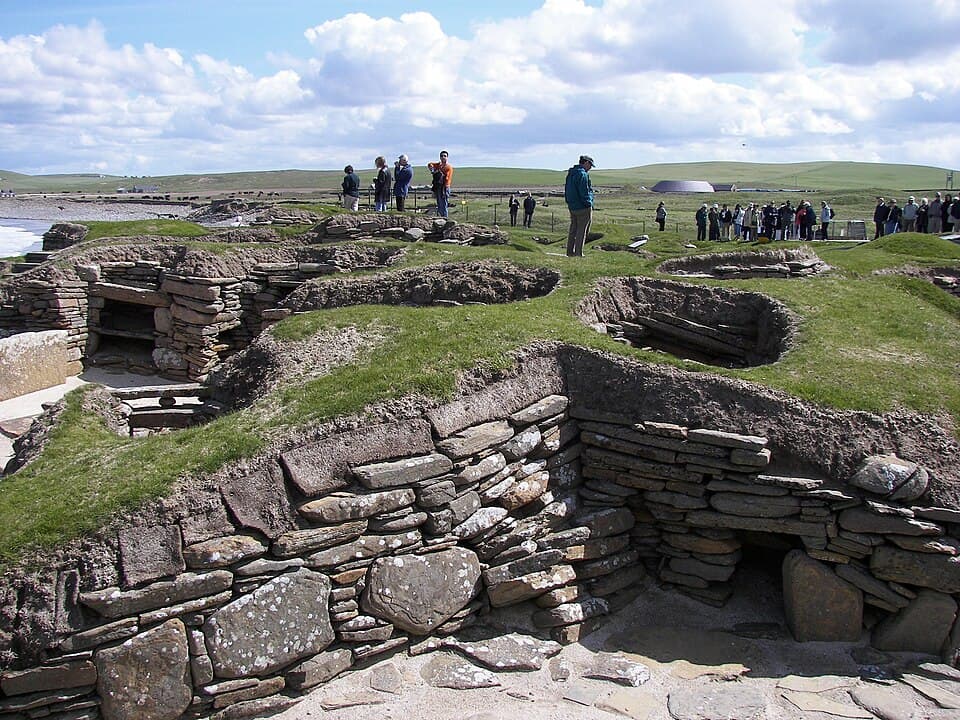
Skara Brae was a community of builders and farmers living in intimate connection with their domestic sacred space. The stone furniture — beds, dressers, hearths — suggests that the home itself was a sacred place, with rituals centered on eating, sleeping, and family gatherings. The dressers were likely display platforms for valuables or ceremonial objects. The beds, still intact, reveal sleeping arrangements: adults on the outer edges, children or servants toward the inside.
The village appears to have been planned and built as a coherent unit, suggesting shared architectural knowledge and values. All houses followed similar floor plans, hinting at shared cultural identity and possibly common leadership or planning. The darkness of the interior spaces (accessed by low passages) suggests intentional light restriction, possibly creating an otherworldly atmosphere for ritual gatherings.
The site's abandonment around 2500 BCE, possibly due to changing climate or migration, left the village frozen in time. A great storm around 1600 BCE buried it under sand dunes, preserving it until its accidental rediscovery in 1850.
Want more like this?
The Weekly Myth hasn't started yet: one sacred site a week, its myth and its history. Leave your email and we'll write when the first one goes out.
We'll only use your email for the Weekly Myth. Unsubscribe anytime.
Themes
The Place
Skara Brae sits on the western shore of the Orkney Mainland, on the Bay of Skaill overlooking the Atlantic Ocean. The village consists of eight houses grouped together, with connecting passages creating a unified complex. Each house is roughly 4 meters square, built entirely of stone with no timber frame. The walls are dry-stacked stone, and the interior is divided by stone partitions.
Interior furnishings are carved from stone: a central hearth, two rectangular beds (one larger than the other) flanking the hearth, and a stone dresser (shelf) facing the entrance. Stone tools, shells, and pottery lie in situ, preserved by the anaerobic sand burial. A small cell-like chamber in some houses may have served for storage or ritual purposes.
The site is now protected by a modern visitor shelter. The landscape is windswept, open moorland with views across the Atlantic. Nearby are other Neolithic sites: Maeshowe (chambered cairn), the Ring of Brodgar, and Stenness, creating a landscape of ritual monuments.
The History
Skara Brae was inhabited from approximately 3100 to 2500 BCE, spanning the late Neolithic period. The village was built as a unified settlement and occupied for at least five centuries. The inhabitants practiced mixed farming (cattle, sheep, pigs) and gathering of shellfish and fish. Pottery was made onsite; evidence of flint knapping indicates tool production.
Around 2500 BCE, the site appears to have been deliberately sealed — doors were blocked, passages filled with stones, and the settlement abandoned. The cause is unclear: environmental deterioration, volcanic activity, or planned closure for ritual reasons have all been proposed. A great storm around 1600 BCE buried the settlement under sand dunes, preserving it perfectly.
The site lay hidden for centuries until 1850, when a storm revealed the stone structures. Modern excavation (1927-1929 and again in the 1970s) revealed the full extent of the village. Skara Brae is now part of the UNESCO World Heritage site 'Heart of Neolithic Orkney,' alongside Maeshowe, Ring of Brodgar, and Stenness.
Frequently Asked
Europe's most complete Neolithic village, with stone furniture still intact, preserved under sand for 4,000 years — home life frozen in time.
Sources
Renfrew, Colin. Before Civilization (1973). Jonathan Cape. Comprehensive study of European Neolithic settlements with detailed analysis of Skara Brae as evidence of complex prehistoric society
Tier 1Childe, Vere Gordon. Skara Brae: A Prehistoric Village in Orkney (1931). Kegan Paul. Original excavation report and analysis of Skara Brae's domestic architecture and material culture
Tier 1Brend, Amanda, Nick Card, Jane Downes, Mark Edmonds and James Moore. Landscapes Revealed: Geophysical Survey in the Heart of Neolithic Orkney World Heritage Area 2002–2011 (UHI Archaeology Institute Research vol. 2) (2020). Oxbow Books / UHI Archaeology Institute. View source → Current Archaeology Book of the Year 2023. Reframes Skara Brae as part of a much larger landscape between it and Maeshowe — the post-Childe / post-Renfrew update needed for an HV+DT site.
Tier 2Card, Nick, Mark Edmonds and Anne Mitchell (eds.). The Ness of Brodgar: As it Stands (2020). The Orcadian Ltd. View source → Authoritative interim synthesis from the Ness excavation team; situates Skara Brae within the contemporary Ness / Stones of Stenness / Ring of Brodgar complex.
Tier 2Related Entries
Pompeii
A Roman city frozen in time by the eruption of Mount Vesuvius in 79 CE — temples, houses, streets, and people preserved in volcanic ash
Campania, Italy
L'Anse aux Meadows
The only confirmed Norse settlement in North America — proof that Vikings reached the Americas 500 years before Columbus
Newfoundland and Labrador, Canada
Chaco Canyon
Ancestral Puebloan ceremonial center with astronomical alignments, Sun Dagger sites, and a network of roads connecting outlying communities
New Mexico, United States
Cradle of Humankind — Sterkfontein Caves
UNESCO World Heritage Site where humanity began — Sterkfontein Caves yielded Mrs. Ples, Little Foot, and Homo naledi, one-third of all known human ancestor fossils
Gauteng, South Africa
Mythic Grounds acknowledges that many sites documented here are sacred to Indigenous peoples and living cultural communities. We strive to present information respectfully, drawing only from published and authorized sources. If you are a member of a community represented on this site and believe any content is inaccurate or culturally inappropriate, please contact us.