 Wikimedia Commons
Muisca confederation, c. 600 CE – 1537 CE; ritual recorded at conquestSacred WaterMythology
Lake Guatavita — El Dorado of the MuiscaMuisca Mythology
The sacred Andean lake where a new Muisca chief, coated in gold dust, made offerings from a raft — the ritual that the Spanish turned into the legend of El Dorado.
The Myth
The Muisca held that certain lakes high in the Andes were doors to the world of the gods, and Lake Guatavita was the greatest of these doors. According to the account the Muisca gave to the Spanish in the 16th century, when a new chief was to be installed at Guatavita, the whole community gathered at the water's edge for one of the most extraordinary rites the Americas ever recorded.
The heir-elect first withdrew into seclusion, fasting in a cave, forbidden to see sunlight or to take salt or women. When he emerged, his naked body was anointed with sticky earth and then blown over with gold dust through hollow canes until he shone from head to foot — the original 'gilded man,' el hombre dorado. At dawn he was carried out onto the lake on a great raft of rushes, heaped with gold and emeralds and accompanied by four richly adorned subordinate chiefs. Around the shore the people burned incense so thick that daylight dimmed, and they sang and played pipes and trumpets.
At the center of the lake the new chief threw his offerings of gold and precious stones into the water as a gift to the goddess who dwelt beneath the surface, then plunged in himself, washing the gold from his body into her keeping. When he rose and the raft returned to shore, he was recognized as the legitimate ruler. The Muisca understood this not as the squandering of treasure but as the proper relationship between a ruler, his people, and the divine: gold belonged to the gods, and the lake was where it was returned to them.
When Spanish conquistadors heard this account, they fixed on the gold and not on its meaning. 'El Dorado,' the Gilded One, slipped loose from Guatavita and grew into a rumor of a golden king, then a golden city, then a golden empire somewhere beyond the next mountain — a phantom that drew expedition after expedition deeper into South America in search of a place that had never existed in the form they imagined.
Want more like this?
The Weekly Myth hasn't started yet: one sacred site a week, its myth and its history. Leave your email and we'll write when the first one goes out.
We'll only use your email for the Weekly Myth. Unsubscribe anytime.
Themes
The Place
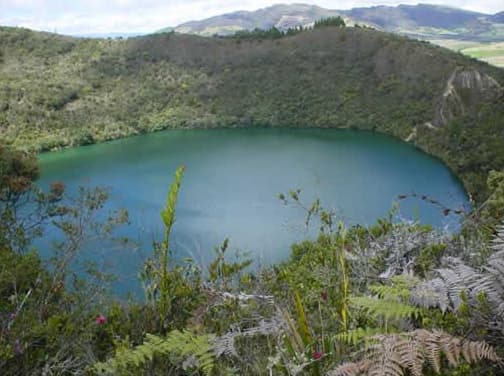
Lake Guatavita is a near-circular lake in the Cordillera Oriental of the Colombian Andes, in the municipality of Sesquilé in Cundinamarca department, roughly 60 kilometers northeast of Bogotá and about 3,100 meters above sea level. Held in a bowl of green hills and ringed by páramo vegetation, the dark water sits in striking isolation — its almost perfect roundness long fueled debate over whether it formed from a meteorite impact, a sinkhole, or a volcanic structure (geologists favor the latter explanations).
Reaching the lake is a managed experience. The site is a protected natural reserve administered by the regional environmental authority (CAR), and visitors enter only with a guide along a trail that climbs through Andean forest to a series of viewpoints above the water. Swimming, boating, and descending to the shoreline are prohibited, both to protect the fragile páramo ecosystem and out of respect for the site's sacred status. A deep V-shaped notch is still visible cut into the lake's rim — the scar left by a colonial-era attempt to drain it.
The town of Guatavita that gave the lake its name was relocated and rebuilt in the 1960s when the original was flooded by the Tominé reservoir; the modern Guatavita is a whitewashed planned town popular with day-trippers from Bogotá. The lake itself remains a place Muisca descendant communities regard as sacred.
The History
Lake Guatavita was a principal ceremonial site of the Muisca confederation, which dominated the Colombian altiplano from roughly the 6th century CE until the Spanish conquest of the 1530s. The investiture ritual described to the Spanish was recorded in several chronicles, most influentially by Juan Rodríguez Freyle in El Carnero (1638), drawing on testimony attributed to a nephew of the last Guatavita chief.
From the conquest onward, Europeans tried repeatedly to recover the gold believed to lie on the lakebed. In the 1580s the merchant Antonio de Sepúlveda mobilized thousands of laborers to cut a notch into the rim and lower the water level, recovering some gold before the channel collapsed and killed many workers. A British company, Contractors Ltd., drained the lake almost completely in 1912, only to watch the exposed mud bake hard as concrete before much could be retrieved; the lake refilled. In 1965 the Colombian government declared it protected and banned further salvage.
The single most important confirmation that the ritual was real came not from Guatavita itself but from a cave near Pasca, where in 1969 laborers found a small tumbaga raft figure inside a ceramic vessel. The 'Balsa Muisca' — a votive miniature showing a central adorned figure surrounded by attendants on a raft — matches the chroniclers' descriptions of the Guatavita ceremony with remarkable fidelity. It is now the centerpiece of the Museo del Oro in Bogotá, home to the world's largest collection of pre-Hispanic goldwork. The raft is physical proof that the Muisca made exactly the kind of offering the El Dorado legend distorted — and a reminder that the legend's enduring power obscured the actual, sophisticated culture that produced it.
Frequently Asked
The sacred Andean lake where a new Muisca chief, gilded in gold dust, made offerings from a raft — the real ritual behind the phantom legend of El Dorado, confirmed by the famous Muisca raft in Bogotá's Gold Museum.
Sources
Museo del Oro (Banco de la República). The Muisca Raft (Balsa Muisca) and the El Dorado Offering. Museo del Oro, Bogotá. View source → The Gold Museum's own documentation of the Balsa Muisca votive raft found near Pasca in 1969, which depicts and archaeologically confirms the Guatavita investiture offering.
Tier 3Juan Rodríguez Freyle. El Carnero (Conquista y descubrimiento del Nuevo Reino de Granada) (1638). Manuscript; modern critical editions. The 1638 chronicle preserving the most detailed early account of the Guatavita gilded-chief investiture ritual, attributed to testimony from the chief's lineage. A colonial-era source — use critically.
Tier 1Related Entries
Niagara Falls — Maid of the Mist
The great cataract where Haudenosaunee traditions tell of Lelawala and the Thunder Beings who dwell behind the falling water
Ontario, Canada
Lake Bosumtwi — Sacred Lake of the Ashanti
The meteorite crater lake in Ghana where the Ashanti believe the souls of the dead come to bid farewell to the god Twi — and where only wooden planks, not boats, may touch the water
Ashanti Region, Ghana
Lake Titicaca — Birthplace of the Sun
The highest navigable lake in the world — where the Inca believed the sun god Inti and the first Inca emerged from the sacred waters at the Island of the Sun
Puno Region / La Paz Department, Peru / Bolivia
Lake Natron
The blood-red soda lake at the foot of the Mountain of God — cradle of 2.5 million flamingos and a landscape of unearthly desolation sacred to the Maasai
Arusha Region, Tanzania
Mythic Grounds acknowledges that many sites documented here are sacred to Indigenous peoples and living cultural communities. We strive to present information respectfully, drawing only from published and authorized sources. If you are a member of a community represented on this site and believe any content is inaccurate or culturally inappropriate, please contact us.