 Wikimedia Commons
Time of the Thunder Beings; ongoing spiritual presenceSacred WaterLegend
Niagara Falls — Maid of the MistGreat Lakes & Eastern Woodlands Mythology
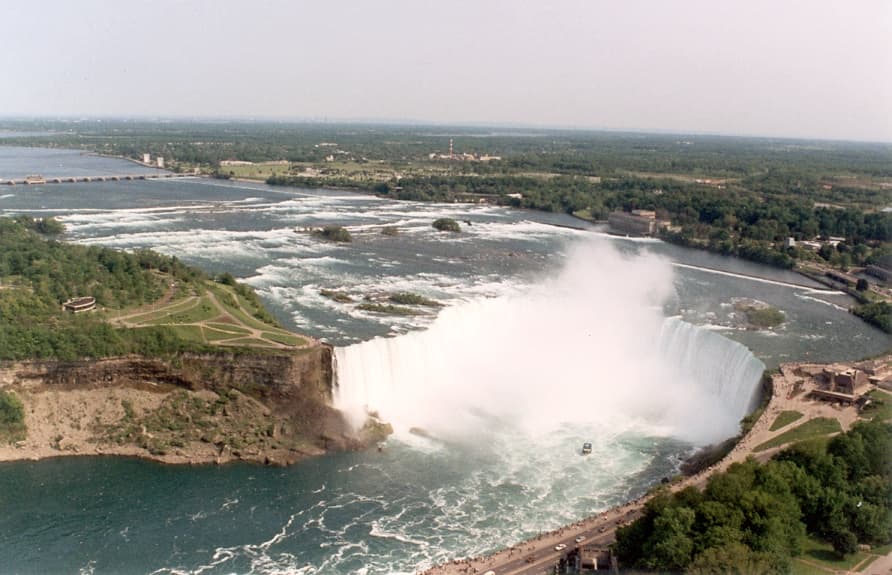
The great cataract where Haudenosaunee traditions tell of Lelawala and the Thunder Beings who dwell behind the falling water
Images via Wikimedia Commons
The Myth
The most widely told legend of Niagara Falls involves a young woman — usually called Lelawala — who goes over the Horseshoe Falls in a canoe. In the version most closely associated with Haudenosaunee (Iroquois) tradition, she is received by the Thunder Beings (Hinon) who live in a great cave behind the curtain of falling water. The Thunder Beings are powerful spiritual entities associated with storms, rain, and the renewal of the earth. They reveal to Lelawala the cause of a pestilence afflicting her people — a great water serpent lurking beneath the river — and she returns with this knowledge to save them.
The Thunder Beings are not merely characters in a single story. In Haudenosaunee cosmology, they are ongoing presences — grandfathers of the storm who protect humanity from malevolent underwater beings. The roar of Niagara is, in one sense, their voice. The perpetual mist rising from the base of the falls is the breath of the spiritual world meeting the physical one.
It is worth noting that the 'Maid of the Mist' story as popularly told has been significantly romanticized and distorted by 19th-century Euro-American writers, who recast Lelawala as a sacrificial maiden sent over the falls. This 'maiden sacrifice' version has no basis in Haudenosaunee tradition and reflects European narrative conventions imposed onto Indigenous stories. The Thunder Being tradition is the authentic core.
Want more like this?
The Weekly Myth hasn't started yet: one sacred site a week, its myth and its history. Leave your email and we'll write when the first one goes out.
We'll only use your email for the Weekly Myth. Unsubscribe anytime.
Themes
The Place
Niagara Falls comprises three waterfalls at the southern end of the Niagara Gorge, straddling the border between Ontario, Canada, and New York, United States. Horseshoe Falls, the largest, is 167 feet high and 2,600 feet wide, carrying roughly 85% of the river's flow. The volume of water — over 750,000 gallons per second at peak flow — makes it one of the most powerful waterfalls in North America.
The falls are the product of glacial retreat at the end of the last ice age, roughly 12,000 years ago. They have been eroding upstream at a rate of roughly 3 feet per year (now slowed by diversion for hydroelectric power). The Niagara Gorge itself is a seven-mile geological record of this retreat. The area immediately surrounding the falls is heavily developed on both the Canadian and American sides.
The History
Archaeological evidence places human habitation in the Niagara region at over 12,000 years, coinciding with the retreat of the Laurentide Ice Sheet. The Haudenosaunee Confederacy — the political and spiritual alliance of the Mohawk, Oneida, Onondaga, Cayuga, Seneca, and Tuscarora nations — has deep roots in the region, with the Seneca nation's traditional territory encompassing the Niagara Frontier.
Charlotte Reeve Conover's 'Concerning Niagara' (1898) collected many of the Euro-American literary treatments of the falls, including romanticized versions of Indigenous legends. Separating authentic Haudenosaunee oral tradition from 19th-century literary invention requires careful attention to sources. The Thunder Being tradition is well-attested in Haudenosaunee ethnography, documented by Arthur C. Parker (Seneca) and others. The sacrificial maiden narrative is a Euro-American overlay.
Frequently Asked
The great cataract where Haudenosaunee tradition places the dwelling of the Thunder Beings — powerful storm spirits who live behind the curtain of falling water.
Sources
Parker, Arthur C.. Seneca Myths and Folk Tales (1923). Buffalo Historical Society. Primary source for Haudenosaunee oral tradition by Seneca anthropologist Arthur C. Parker
Tier 1Conover, Charlotte Reeve. Concerning Niagara (1898). Early compilation of legends and literary treatments of Niagara Falls
Tier 2Related Entries
Effigy Mounds, Iowa — Sacred Earthworks
Bird and bear mounds built by Woodland peoples 1,400+ years ago along the bluffs of the Upper Mississippi
Iowa, United States
Sleeping Bear Dunes — Manitou Islands
The Ojibwe legend of a mother bear waiting for her drowned cubs — turned to sand and stone by the Great Spirit Manitou
Michigan, United States
Lake Bosumtwi — Sacred Lake of the Ashanti
The meteorite crater lake in Ghana where the Ashanti believe the souls of the dead come to bid farewell to the god Twi — and where only wooden planks, not boats, may touch the water
Ashanti Region, Ghana
Lake Titicaca — Birthplace of the Sun
The highest navigable lake in the world — where the Inca believed the sun god Inti and the first Inca emerged from the sacred waters at the Island of the Sun
Puno Region / La Paz Department, Peru / Bolivia
Mythic Grounds acknowledges that many sites documented here are sacred to Indigenous peoples and living cultural communities. We strive to present information respectfully, drawing only from published and authorized sources. If you are a member of a community represented on this site and believe any content is inaccurate or culturally inappropriate, please contact us.