 Wikimedia Commons
Approximately 1070 CE (disputed; possibly much older)Effigy / EarthworkMythology
Serpent MoundAmerican Folklore Mythology
A 1,348-foot serpent effigy undulating along a hilltop in rural Ohio — its open jaws aligned to the summer solstice sunset
Images via Wikimedia Commons
The Myth
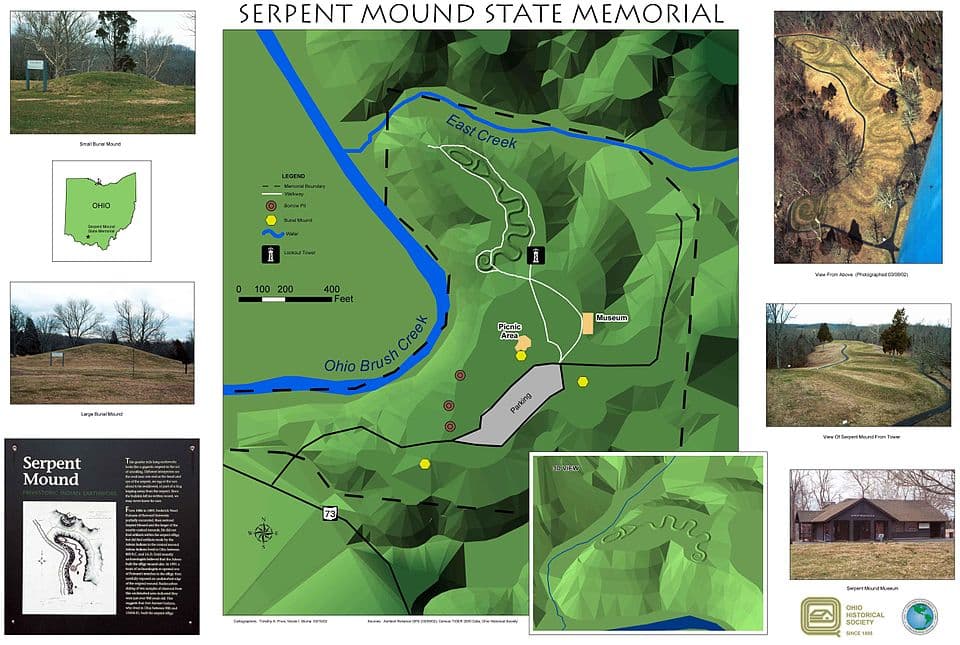
No written record from the builders of Serpent Mound survives. The mound speaks entirely through its form: a serpent, 1,348 feet long and roughly 3 feet tall, its body curving in seven deep coils along the edge of a plateau overlooking Brush Creek. At its western end, the serpent's open jaws appear to be swallowing an oval shape — variously interpreted as an egg, the sun, or a frog.
The serpent is a universal symbol in the mythologies of Eastern Woodland peoples. The Underwater Panther and the Horned Serpent are powerful figures in the cosmologies of the Shawnee, Miami, and other peoples who inhabited Ohio in later centuries. Whether the builders of the mound intended the same associations is unknowable — but the form is unmistakable. This is a serpent. It was placed here deliberately. And its head points at the summer solstice sunset.
The oval in the serpent's jaws aligns with the setting sun on the summer solstice. Additional alignments with solstice sunrise, equinox sunrise, and lunar standstill positions have been proposed, suggesting the mound functioned as an astronomical instrument — a calendar built into the earth in the shape of a living thing.
Want more like this?
The Weekly Myth hasn't started yet: one sacred site a week, its myth and its history. Leave your email and we'll write when the first one goes out.
We'll only use your email for the Weekly Myth. Unsubscribe anytime.
Themes
The Place
Serpent Mound sits on a plateau above Brush Creek in Adams County, Ohio — deep rural Appalachia, roughly 75 miles east of Cincinnati. The site is managed by the Ohio History Connection as a state memorial. A paved path follows the serpent's length, and an observation tower provides an overhead view.
The hilltop itself sits within the Serpent Mound Cryptoexplosion Structure — a geological formation roughly 4.5 miles across, likely caused by a meteorite impact approximately 300 million years ago. The builders placed their serpent on the rim of an ancient impact crater. Whether they knew what lay beneath them is one of the site's many unanswerable questions.
The History
Dating Serpent Mound has been contentious. Earlier attributions placed it with the Adena culture (circa 800 BCE-100 CE), but radiocarbon dating of charcoal from within the mound in 1996 yielded dates around 1070 CE, coinciding with the Fort Ancient culture and — notably — with the appearance of Halley's Comet in 1066 and the supernova of 1054 (which created the Crab Nebula).
Some researchers have proposed that the mound was built in response to one of these celestial events. If the 1070 date is correct, the serpent swallowing a cosmic object takes on a specific and startling meaning.
The mound was first surveyed by Ephraim Squier and Edwin Davis in 1846. Frederic Ward Putnam of Harvard's Peabody Museum raised funds to purchase the site in the 1880s, preventing its destruction by farming. It was designated a National Historic Landmark in 1966 and is on the U.S. Tentative List for UNESCO World Heritage status.
Frequently Asked
A 1,348-foot serpent effigy on an Ohio hilltop, its jaws swallowing the summer solstice sunset — built on the rim of a 300-million-year-old meteorite crater, possibly in response to Halley's Comet.
Sources
Lepper, Bradley T.. Serpent Mound in its Woodland Period Context (with rejoinders) (2019). Midcontinental Journal of Archaeology, vol. 44, no. 1. View source → Lepper's peer-reviewed defence of a Fort Ancient–era construction date (c. 1070 CE) against the Adena-era reading. Centrepiece of the current dating debate.
Tier 2Romain, William F.. Mysteries of the Hopewell: Astronomers, Geometers, and Magicians of the Eastern Woodlands (2000). University of Akron Press. Romain's argument situating Serpent Mound in an earlier Adena/Hopewell context, including its astronomical alignments. The other side of the ongoing dating debate.
Tier 2Ohio History Connection. Serpent Mound — Site Documentation and Indigenous Connections (2023). Ohio History Connection. View source → Site manager's current statement on dating, indigenous attribution, and UNESCO World Heritage nomination status (inscribed 2023 as part of Hopewell Ceremonial Earthworks).
Tier 3Related Entries
Cahokia Monks Mound
The largest earthen structure in the Americas — the center of a city that was bigger than London in 1100 CE and was abandoned before Europeans arrived
Illinois, United States
Devils Tower
The igneous monolith sacred to over 20 tribal nations, known to the Lakota as Mato Tipila — Bear Lodge
Wyoming, United States
Sleepy Hollow
The Dutch colonial village where Washington Irving's Headless Horseman rides — and where the real history is stranger than the fiction
New York, United States
Roanoke Island
The colony that vanished in 1590, leaving only the word CROATOAN carved into a post — America's oldest unsolved mystery
North Carolina, United States
Mythic Grounds acknowledges that many sites documented here are sacred to Indigenous peoples and living cultural communities. We strive to present information respectfully, drawing only from published and authorized sources. If you are a member of a community represented on this site and believe any content is inaccurate or culturally inappropriate, please contact us.