 Wikimedia Commons
1966-1967; ongoing in folkloreFolklore SiteFolktale
Mothman BridgeAmerican Folklore Mythology
The Silver Bridge collapse and the Mothman sightings that preceded it
Images via Wikimedia Commons
The Myth
Between November 1966 and December 1967, residents of Point Pleasant, West Virginia reported sightings of a large, winged creature with glowing red eyes — the Mothman. Witnesses described it as 6-7 feet tall with a wingspan of 10-15 feet. Sightings were concentrated around the old TNT area, a World War II munitions storage site north of town.
On December 15, 1967, the Silver Bridge — connecting Point Pleasant to Gallipolis, Ohio — collapsed during rush hour, killing 46 people. The Mothman sightings ceased after the collapse, and the creature became permanently associated with the disaster in local folklore. Whether the Mothman was a harbinger, a coincidence, or something else entirely depends on who you ask.
Want more like this?
The Weekly Myth hasn't started yet: one sacred site a week, its myth and its history. Leave your email and we'll write when the first one goes out.
We'll only use your email for the Weekly Myth. Unsubscribe anytime.
Themes
The Place
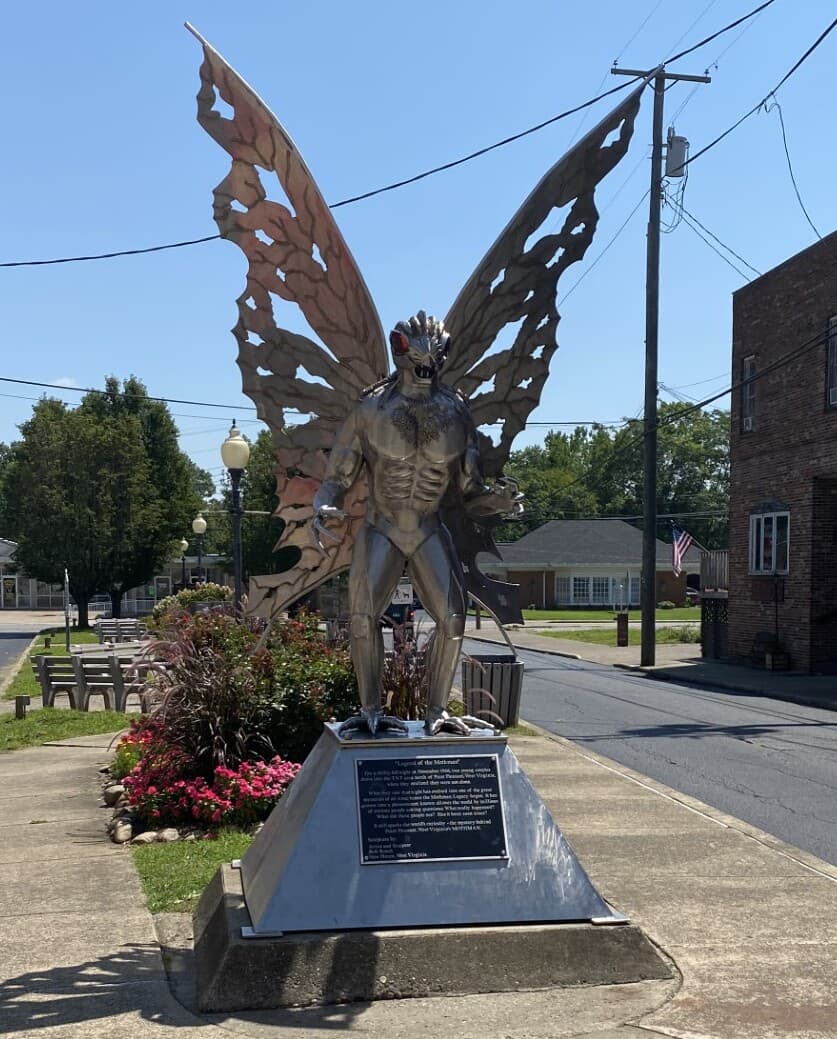
Point Pleasant sits at the confluence of the Ohio and Kanawha Rivers in Mason County, West Virginia. The town of roughly 4,000 people has embraced its Mothman heritage — a 12-foot stainless steel Mothman statue stands in the center of town, and the Mothman Museum draws visitors year-round. The annual Mothman Festival in September brings 10,000-12,000 visitors.
The TNT area (McClintic Wildlife Management Area) where many sightings occurred is accessible but overgrown. The Silver Bridge site is marked by a memorial on the riverbank.
The History
The Silver Bridge was an eyebar chain suspension bridge built in 1928. Investigation by the NTSB determined that a single eyebar in the suspension chain had developed a stress corrosion crack over decades, leading to catastrophic failure. The bridge's unique design meant that a single point of failure could bring down the entire structure.
John Keel's 1975 book The Mothman Prophecies brought the story to national attention. Explanations for the sightings range from a large barred owl or sandhill crane to mass hysteria in a stressed community. The story represents a distinctly American type of folklore — the modern legend that grows from a real community trauma.
Frequently Asked
Before the Silver Bridge collapsed and killed 46 people in 1967, residents of Point Pleasant reported sightings of a winged creature with glowing red eyes. The Mothman became one of America's most enduring modern legends.
Sources
Keel, John A.. The Mothman Prophecies (1975). Saturday Review Press / E. P. Dutton. Keel's compilation of contemporary witness interviews, newspaper reports, and his own investigation in Point Pleasant 1966-1967. The foundational text of the Mothman tradition. Popular rather than academic, but the canonical source for the witness corpus.
Tier 2Sergent, Donnie Jr. and Jeff Wamsley. Mothman: The Facts Behind the Legend (2002). Mothman Lives Publishing, Point Pleasant. Local Point Pleasant compilation drawing on community memory, the Silver Bridge collapse record, and first-generation witness testimony. Useful corrective to Keel's more speculative framing.
Tier 2National Transportation Safety Board. Highway Accident Report: Collapse of US 35 Highway Bridge, Point Pleasant, West Virginia, December 15, 1967 (1971). NTSB, Washington, D.C.. View source → Official NTSB report on the Silver Bridge collapse — establishes the eyebar stress-corrosion failure cause and the 46-fatality count that the folklore frames as the Mothman's prophesied event.
Tier 3Related Entries
Sleepy Hollow
The Dutch colonial village where Washington Irving's Headless Horseman rides — and where the real history is stranger than the fiction
New York, United States
Roanoke Island
The colony that vanished in 1590, leaving only the word CROATOAN carved into a post — America's oldest unsolved mystery
North Carolina, United States
The Jersey Devil Birthplace
The Pine Barrens homestead where Mother Leeds gave birth to her 13th child — and it flew up the chimney
New Jersey, United States
Spook Hill
A stretch of road in central Florida where cars appear to roll uphill — explained by the Seminole as the resting place of a great alligator killed in battle
Florida, United States
Mythic Grounds acknowledges that many sites documented here are sacred to Indigenous peoples and living cultural communities. We strive to present information respectfully, drawing only from published and authorized sources. If you are a member of a community represented on this site and believe any content is inaccurate or culturally inappropriate, please contact us.