 Wikimedia Commons
300-800 years ago; ongoing ceremonial usePilgrimage SiteLiving tradition
Medicine Wheel, Wyoming — Sacred ObservatoryPlains Nations Mythology
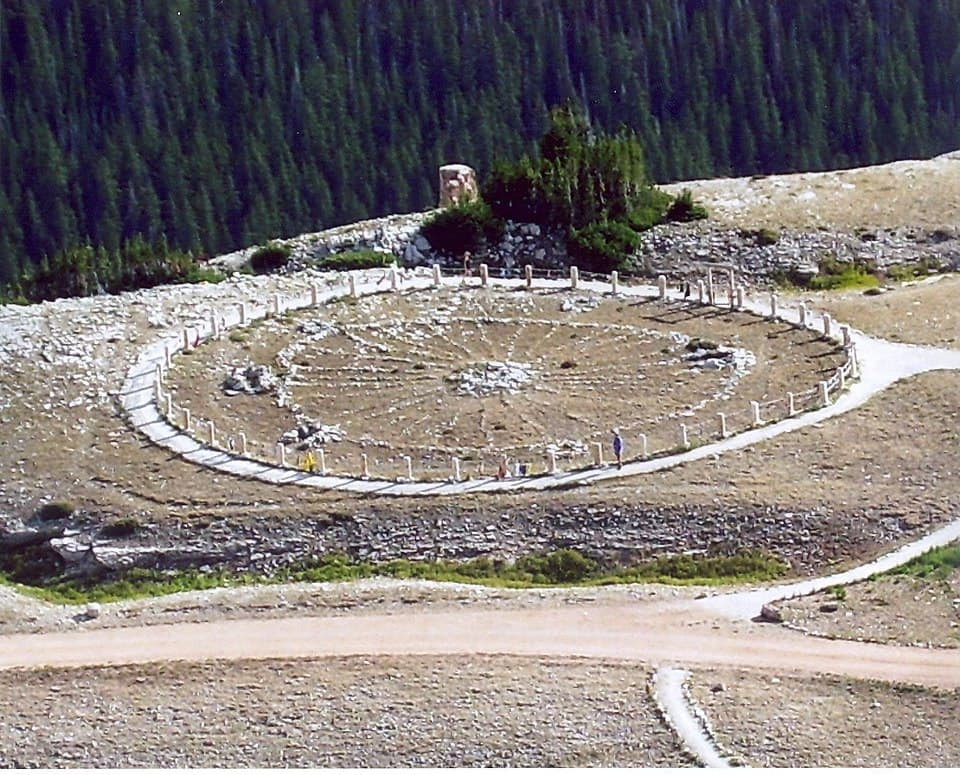
A stone circle at 9,642 feet aligned to the summer solstice sunrise, sacred to many Plains nations for centuries
Images via Wikimedia Commons
The Myth
The Bighorn Medicine Wheel is a stone circle roughly 80 feet in diameter with 28 spokes radiating from a central cairn, situated on an exposed ridge at 9,642 feet elevation in the Bighorn Mountains. It is sacred to multiple Plains nations — Crow, Cheyenne, Lakota, Arapaho, Shoshone, and others — each of whom has distinct traditions regarding its origin and purpose.
Crow oral tradition attributes the wheel's construction to the culture hero Red Plume. Cheyenne tradition connects it to the prophet Sweet Medicine. For many Plains peoples, the site is a place of vision questing, prayer, and offering — the high elevation and exposed location making it a place where the sky world feels close. Offerings of tobacco, cloth, and sage are left at the cairns.
The 28 spokes have been interpreted as corresponding to the 28 days of the lunar cycle, connecting the wheel to Plains traditions of astronomical observation and ceremonial calendars. The site's power is understood as deriving from its position — high, exposed, at the boundary between earth and sky, visible for miles across the surrounding ridges and valleys.
Want more like this?
The Weekly Myth hasn't started yet: one sacred site a week, its myth and its history. Leave your email and we'll write when the first one goes out.
We'll only use your email for the Weekly Myth. Unsubscribe anytime.
Themes
The Place
The Medicine Wheel sits on the western shoulder of Medicine Mountain in the Bighorn Range, at an elevation of 9,642 feet. The site is above treeline, on an exposed alpine ridge with panoramic views of the Bighorn Basin to the west and the Bighorn Mountains to the east. Snow covers the site for much of the year; it is typically accessible only from late June through September.
The wheel is reached via a 1.5-mile gravel road/trail from the parking area on US Highway 14A (Bighorn Scenic Byway). A rope fence surrounds the wheel to prevent damage. The site is managed by the Bighorn National Forest in consultation with tribal nations.
The History
Astronomer John A. Eddy published 'Astronomical Alignment of the Big Horn Medicine Wheel' in Science magazine in 1974, demonstrating that the cairns at the wheel's rim align with the summer solstice sunrise and sunset, as well as with the rising points of the stars Aldebaran, Rigel, and Sirius. Eddy's work placed the Medicine Wheel in the context of archaeoastronomy — the study of how ancient peoples tracked celestial events through architectural alignments.
The wheel's construction date is uncertain. Estimates range from 300 to 800 years old, though some scholars suggest components may be older. The site was designated a National Historic Landmark in 1970. In 1996, a Historic Preservation Plan developed in consultation with tribal representatives established protocols for balancing public access with ceremonial use. The Medicine Wheel remains an active ceremonial site — not a ruin but a living place of worship.
Frequently Asked
A stone circle at 9,642 feet in the Bighorn Mountains, aligned to the summer solstice and sacred to multiple Plains nations — a living ceremonial site, not a ruin.
Sources
Eddy, John A.. Astronomical Alignment of the Big Horn Medicine Wheel (1974). Science, Vol. 184, No. 4141. Landmark archaeoastronomy paper demonstrating solstice and stellar alignments at the Medicine Wheel
Tier 1Related Entries
Pipestone National Monument — Sacred Quarry
The red catlinite quarry considered sacred neutral ground by dozens of Plains and Woodlands nations for centuries
Minnesota, United States
El Santuario de Chimayo
A small adobe chapel in northern New Mexico where the dirt is believed to heal — the Lourdes of America
New Mexico, United States
New Orleans — Marie Laveau and Voodoo
St. Louis Cemetery No. 1 and the legacy of the Voodoo Queen — where African, Catholic, and Creole spiritual traditions became something new
Louisiana, United States
Bodh Gaya — Seat of Enlightenment
The site where Siddhartha Gautama attained enlightenment beneath the Bodhi Tree — the spiritual center of Buddhism and a pilgrimage destination for 2,500 years
Bihar, India
Mythic Grounds acknowledges that many sites documented here are sacred to Indigenous peoples and living cultural communities. We strive to present information respectfully, drawing only from published and authorized sources. If you are a member of a community represented on this site and believe any content is inaccurate or culturally inappropriate, please contact us.