 Wikimedia Commons
CultureMesoamericaLiving tradition
Maya
The Maya civilization of Yucatan, Guatemala, and Belize — from the Popol Vuh to the living Maya today.
The Maya civilization spans over 3,000 years, from the Preclassic period to the present day. Over 6 million Maya people live in Mexico, Guatemala, Belize, Honduras, and El Salvador today, speaking more than 30 distinct Maya languages. Their mythological tradition is preserved in the K'iche' Popol Vuh — one of the great mythological texts of any civilization — and in living oral tradition that continues to evolve.
The Hero Twins narrative at the heart of the Popol Vuh is a sophisticated cosmological story: Hunahpu and Xbalanque descend into Xibalba, the Maya underworld, defeat the lords of death through wit and transformation, and set in motion the creation of the current humanity from maize. Xibalba was not purely metaphorical — cenotes, the great sinkholes of the Yucatan, were understood as portals to this underworld. The Maya deposited offerings, and sometimes sacrificial victims, into their waters. Cenote Sagrada at Chichen Itza yielded extraordinary quantities of jade, gold, and human bone when dredged in the early 20th century.
Maya astronomical precision is encoded in stone. El Castillo at Chichen Itza is oriented so that on the spring and autumn equinoxes, shadow and light create the illusion of a serpent descending the staircase — a phenomenon that draws tens of thousands of visitors today. The Dresden Codex, one of only four surviving pre-Columbian Maya books, contains astronomical tables of extraordinary accuracy, including a Venus almanac that tracks the planet's cycles with an error of only 14 seconds per year.
Living Maya ceremony today includes the Ch'a Chaak rain ceremony, the Hanal Pixan (Day of the Dead) as practiced in Yucatan, and the work of ajq'ijab — Maya daykeepers — who maintain the 260-day sacred calendar as a living divinatory practice across the highlands of Guatemala.
5 entries mapped
 Wikimedia Commons
MayaLiving traditionUNESCO
Chichen Itza
The Maya city where the feathered serpent descends the pyramid at every equinox
Merida, Yucatan, Mexico
 Wikimedia Commons
MayaUNESCO
Palenque
The Maya city in the Chiapas jungle where K'inich Janaab Pakal was buried inside a pyramid with a sarcophagus lid depicting his descent into the underworld
Villahermosa, Tabasco (90 miles north), Mexico
 Wikimedia Commons
Maya
Cenote Ik Kil
A cathedral-sized sinkhole near Chichen Itza where vines fall 85 feet to turquoise water — one of the Yucatan's ancient portals to the underworld
Valladolid, Yucatan (25 miles east), Mexico
 Wikimedia Commons
MayaUNESCO
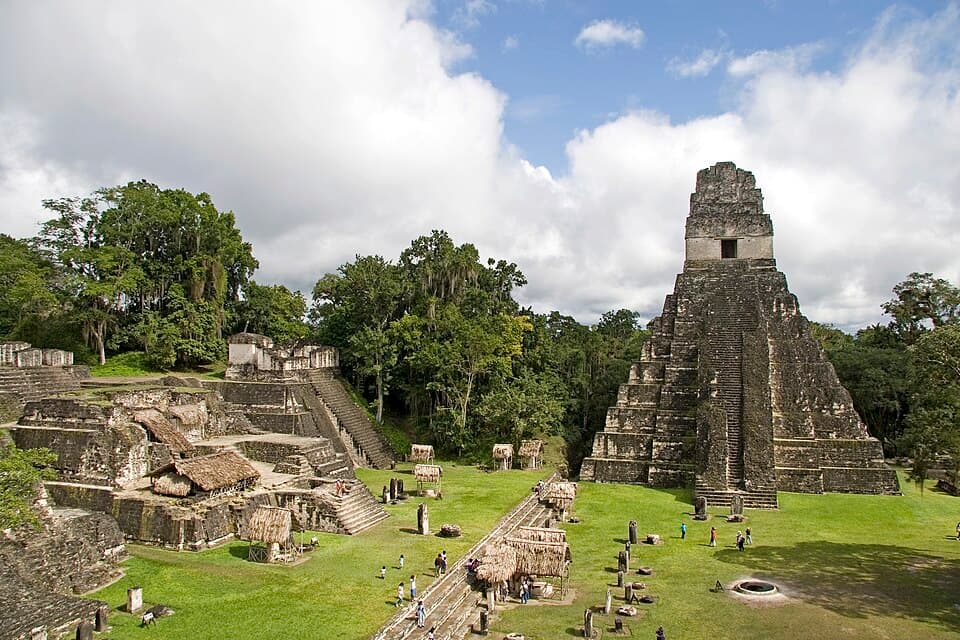
Tikal
The largest Maya city, rising from the rainforest — temples rivaling medieval cathedrals in height, home of the Great Jaguar and the cosmos in stone
Flores, Guatemala
 Wikimedia Commons
Maya
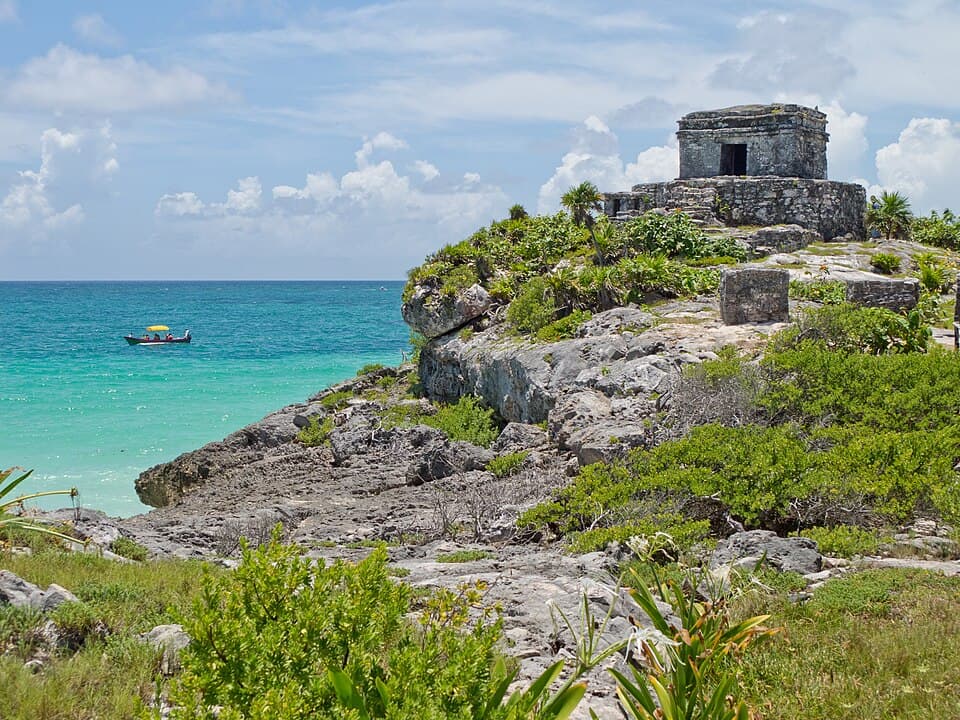
Tulum
Clifftop Maya city overlooking the Caribbean — one of the last major Maya cities, serving as a port and trading center in the Postclassic period
Playa del Carmen, Quintana Roo, Mexico (65 km north)