 Wikimedia Commons
CultureLevant / Global
Abrahamic — Judaism
The holy sites of Judaism: the Jerusalem Temple, the Western Wall, the Caves of the Patriarchs — where the covenant between God and the Jewish people was established.
Judaism is the world's oldest monotheistic religion, with three thousand years of recorded history. Its sacred geography centers on the Land of Israel (Eretz Yisrael): Jerusalem, site of the Temple where God's presence dwelled; the Cave of Machpelah in Hebron, the burial place of the Patriarchs and Matriarchs; the Jordan River, where Joshua led the people into the Promised Land; Mount Sinai, where Torah was revealed to Moses; and countless locations hallowed by biblical narrative. The Temple's destruction (70 CE) transformed Judaism from a temple-based religion to a text-based one, with Torah and Talmud replacing sacrificial ritual. The Western Wall, the only surviving structure of the Second Temple, became Jewry's holiest site. Contemporary Judaism is deeply tied to the State of Israel and the return to ancestral lands — a fulfillment of millennia of diaspora. Judaism is a living tradition with diverse branches (Orthodox, Conservative, Reform, Reconstructionist, Renewal), yet unified by the Torah and the covenant.
3 entries mapped
 Wikimedia Commons
Abrahamic — JudaismUNESCO
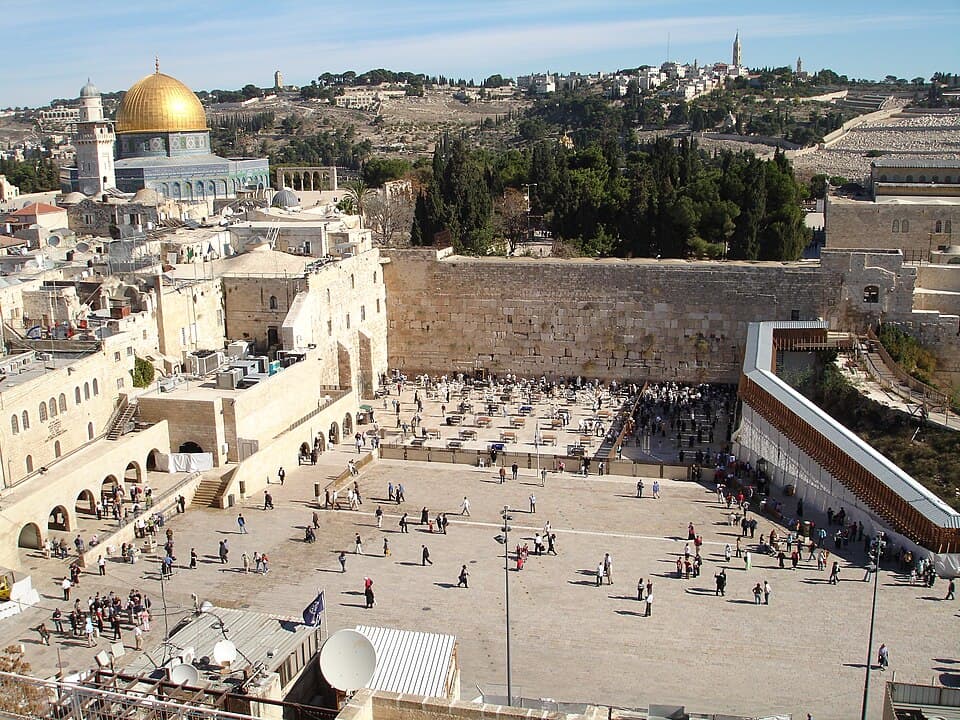
The Western Wall & Temple Mount
The holiest site in Judaism — the last remnant of the Second Temple and the contested sacred ground where Judaism, Christianity, and Islam intersect
Jerusalem, Israel/Palestine
 Wikimedia Commons
Abrahamic — JudaismUNESCO
Mount Sinai (Jebel Musa)
Where God gave Moses the Ten Commandments and the Torah — the sacred mountain where Judaism, Christianity, and Islam converge
Nuweiba, Egypt
 Wikimedia Commons
Abrahamic — JudaismUNESCO
Masada
Herod's mountaintop fortress overlooking the Dead Sea — site of the last stand of Jewish resistance against Rome, symbol of Jewish resilience and resolve
Ein Gedi, Dead Sea, Israel