 Wikimedia Commons
Second Temple period — c. 516 BCE-70 CETemple / RuinsUNESCO World HeritageMythology
The Western Wall & Temple MountAbrahamic — Judaism Mythology
The holiest site in Judaism — the last remnant of the Second Temple and the contested sacred ground where Judaism, Christianity, and Islam intersect
Cultural sensitivity notice
The Temple Mount / Haram al-Sharif is among the most contested sacred spaces on Earth. It is holy to Judaism, Christianity, and Islam. Mythic Grounds presents the perspectives of each tradition with respect and does not take a political position on sovereignty. Visitors should be aware of access restrictions and dress codes enforced by religious authorities.
The Myth
The Western Wall, known as the Kotel in Hebrew, is the earthly anchor point of Jewish spiritual identity and connection to God. The wall is the last remnant of the retaining wall that enclosed the Temple Mount, and touching it is to place one's hand on the only surviving structure built during the time of the Second Temple. The Temple itself, destroyed by the Romans in 70 CE, was believed to house the Holy of Holies (Kodesh HaKodashim) — the innermost sanctum where God's presence (Shekinah) dwelled invisibly.
The Temple Mount above the wall is believed to be the location of the Foundation Stone (Even HaShtiyah), the point from which creation began. It is here that Abraham bound Isaac in the covenant sacrifice. The rock itself is considered a cosmic axis — the point where heaven and earth touch. Muslims call this rock the Navel of the Earth.
For nearly two millennia, Jews have come to the Western Wall to pray, leaving notes with petitions in the cracks between stones. The custom reflects the belief that the wall still maintains a connection to the holy temple and to God. Orthodox Jewish prayer at the wall is accompanied by bodily swaying (davening), the rhythmic movement that some interpret as harmonizing with cosmic vibration.
Want more like this?
The Weekly Myth hasn't started yet: one sacred site a week, its myth and its history. Leave your email and we'll write when the first one goes out.
We'll only use your email for the Weekly Myth. Unsubscribe anytime.
Themes
The Place
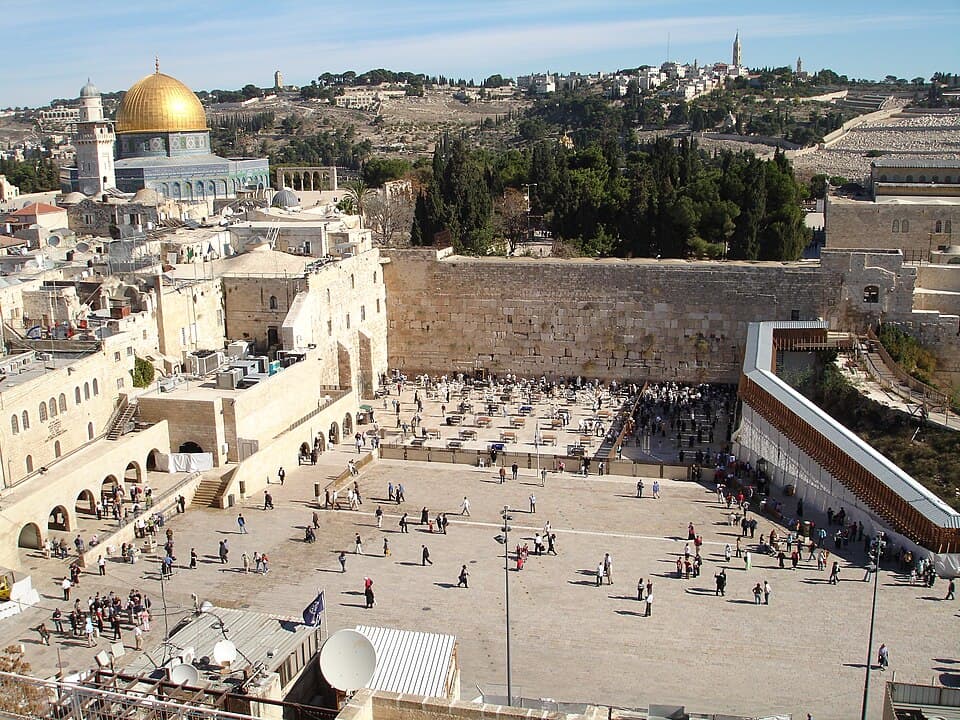
The Western Wall stands at the western edge of the Temple Mount platform in Jerusalem's Old City, accessed through a plaza that can accommodate tens of thousands of worshippers. The wall itself is approximately 488 meters long, though only a small section (about 57 meters) is exposed and accessible to the public in the Western Wall Plaza. The rest of the wall lies beneath later Islamic structures, including the Al-Aqsa Mosque and the Dome of the Rock.
The visible stones of the wall are massive limestone blocks, some dating to Herod the Great's construction in the 1st century BCE, others to later Islamic and medieval periods. The largest stone weighs approximately 570 tons. Pilgrims and worshippers crowd the plaza daily, separated by a barrier into male and female sections (in the Orthodox section), reflecting religious tradition.
The Temple Mount platform above rises dramatically, crowned by the Dome of the Rock (the golden dome visible across Jerusalem) and the Al-Aqsa Mosque. The entire area is surrounded by the Old City's medieval walls and densely packed houses.
The History
The Second Temple was built around 516 BCE after the Jewish return from Babylonian exile and was magnificently expanded by King Herod the Great (r. 37-4 BCE). The temple served as the center of Jewish religious life for over 600 years until its destruction during the Roman siege of Jerusalem in 70 CE.
After the temple's destruction, only the western retaining wall survived. In the centuries following, Jews made pilgrimage to the wall to pray, even under prohibitive Islamic and Ottoman rulers. The wall became the most accessible substitute for the destroyed temple and evolved into the focus of Jewish prayer, particularly after the establishment of the Western Wall as a permanent prayer site in the 16th century.
The site has been continuously contested. In 1967, after the Six-Day War, Israel gained control of the Old City, and the Western Wall became the center of Jewish spiritual life in Israel. The Temple Mount remains under joint but complex governance, accessible to non-Muslims only during limited hours and subject to restrictions. The contested status of the site makes it one of Earth's most politically fraught sacred spaces.
Frequently Asked
The holiest site in Judaism, the last remnant of the Second Temple and the contended sacred ground where Abraham's covenant is anchored.
Sources
Shanks, Hershel. Jerusalem: An Archaeological Biography (2014). HarperOne. Comprehensive history of Jerusalem's sacred sites including the Western Wall and Temple Mount
Tier 1Mazar, Benjamin. The Mountain of the Lord: Excavating the Ancient Temple Mount (2013). Israel Exploration Society. Archaeological study of Temple Mount excavations and the Western Wall's structure
Tier 2Related Entries
Mount Sinai (Jebel Musa)
Where God gave Moses the Ten Commandments and the Torah — the sacred mountain where Judaism, Christianity, and Islam converge
South Sinai Governorate, Egypt
Teotihuacan
The ancient city where the gods sacrificed themselves to create the Fifth Sun
State of Mexico, Mexico
Chichen Itza
The Maya city where the feathered serpent descends the pyramid at every equinox
Yucatan, Mexico
Templo Mayor
The center of the Aztec universe — buried beneath Mexico City for 500 years, rediscovered by electrical workers in 1978
CDMX, Mexico
Mythic Grounds acknowledges that many sites documented here are sacred to Indigenous peoples and living cultural communities. We strive to present information respectfully, drawing only from published and authorized sources. If you are a member of a community represented on this site and believe any content is inaccurate or culturally inappropriate, please contact us.