 Wikimedia Commons
Maya Postclassic — c. 1200-1521 CETemple / RuinsMythology
TulumMaya Mythology
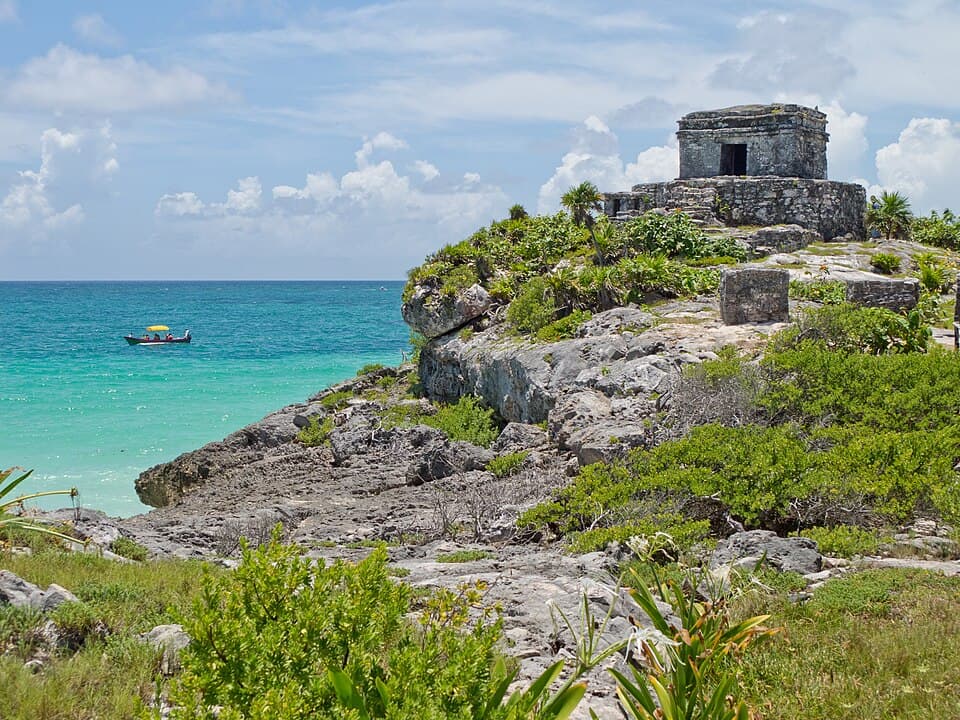
Clifftop Maya city overlooking the Caribbean — one of the last major Maya cities, serving as a port and trading center in the Postclassic period
The Myth
Tulum was the domain of the Descending God, also known as Ah Muzen Cab (the bee god) or the god of maize and commerce. The Temple of the Descending God features a striking image of a deity descending head-first from the heavens, likely representing the sun's daily descent, the descent of the rain god, or commerce flowing downward from the gods to humanity. This inverted pose suggests a god actively engaged with the human realm — not distant and transcendent but intimate and present.
Tulum served as a port for long-distance trade, with merchants bringing jade, cacao, obsidian, and other precious goods. The mercantile god Ek Chuaj was venerated as the patron of traders and roads. The Temple of the Frescoes displays surviving murals depicting deities, processions, and cosmological scenes, suggesting rituals tied to trade and prosperity.
The city's location on the Caribbean coast connected it to maritime trade networks extending to Central America and South America. This was late Maya civilization (1200-1521 CE), when the great Classic Maya cities of the Petén had already collapsed centuries earlier. Tulum represents Maya resilience and adaptation — a culture that persisted and even flourished in new forms.
Want more like this?
The Weekly Myth hasn't started yet: one sacred site a week, its myth and its history. Leave your email and we'll write when the first one goes out.
We'll only use your email for the Weekly Myth. Unsubscribe anytime.
Themes
The Place
Tulum perches on limestone cliffs approximately 12 meters above the Caribbean Sea, creating a dramatic setting. The site is surrounded by a defensive wall (an unusual feature for Maya cities), measuring roughly 400 by 200 meters, with entry gates on the north, west, and south sides. The wall suggests either defense against rival Maya groups or a ritual boundary marking sacred space.
Inside the walls, structures are arranged along a north-south axis, with the most prominent buildings clustered near the cliff edge. El Castillo (the castle), a steep-sided pyramid approximately 7-8 meters tall, dominates the site. The Temple of the Frescoes sits to the south, its outer walls decorated with stucco reliefs. Smaller shrines and residential structures scatter throughout. The beach directly below the cliff was likely used for canoe landing and maritime trade.
The surrounding landscape is tropical forest (selva), with cenotes (sinkholes) providing freshwater nearby. The site sits on the Yucatan Peninsula's eastern tip, where trade winds and currents favor maritime traffic.
The History
Tulum was settled around 1200 CE and flourished through the 15th century before the Spanish conquest. It reached its height as a port city in the 14th-16th centuries, when it was part of the Cozumel confederation of coastal trading cities. The site was inhabited through the Spanish contact period — Spanish conquistadors noted the white-painted walls of Tulum visible from the sea, and the city was one of the last major Maya centers to be conquered (around 1521-1530 CE).
The site's continuous occupation ended during the colonial period, likely due to European disease, conquest, and disruption of trade networks. The forest reclaimed Tulum until its rediscovery by John Lloyd Stephens in the 19th century. Modern excavation and stabilization began in the mid-20th century. Today, Tulum is one of Mexico's most visited archaeological sites, a testament to its dramatic setting and significance.
Frequently Asked
Clifftop Maya trading city overlooking the Caribbean, featuring the Temple of the Descending God and distinctive defensive wall — one of the last major Maya centers.
Sources
Miller, Arthur G.. The Painted Tombs of Tulum (1982). University of Arizona Press. Archaeological study of Tulum's art, murals, and religious significance as a Late Postclassic Maya port city
Tier 1Coe, Michael D.. The Maya (8th edition) (2011). Thames and Hudson. Authoritative overview of Maya civilization including Postclassic cities like Tulum
Tier 2Related Entries
Teotihuacan
The ancient city where the gods sacrificed themselves to create the Fifth Sun
State of Mexico, Mexico
Templo Mayor
The center of the Aztec universe — buried beneath Mexico City for 500 years, rediscovered by electrical workers in 1978
CDMX, Mexico
Mesa Verde — Ancestral Puebloan Cliff Dwellings
The cliff palaces of the Ancestral Puebloans, abandoned circa 1300 CE, central to Hopi and Pueblo origin narratives
Colorado, United States
Monte Alban — Zapotec City of the Clouds
The hilltop capital of the Zapotec civilization, occupied 500 BCE-700 CE, with an astronomical observatory and carved figures depicting captives and sacrificial victims
Oaxaca, Mexico
Mythic Grounds acknowledges that many sites documented here are sacred to Indigenous peoples and living cultural communities. We strive to present information respectfully, drawing only from published and authorized sources. If you are a member of a community represented on this site and believe any content is inaccurate or culturally inappropriate, please contact us.