 Wikimedia Commons
Classic Maya — 600 BCE to 900 CE (peak 700-800 CE)Temple / RuinsUNESCO World HeritageMythology
TikalMaya Mythology
The largest Maya city, rising from the rainforest — temples rivaling medieval cathedrals in height, home of the Great Jaguar and the cosmos in stone
The Myth
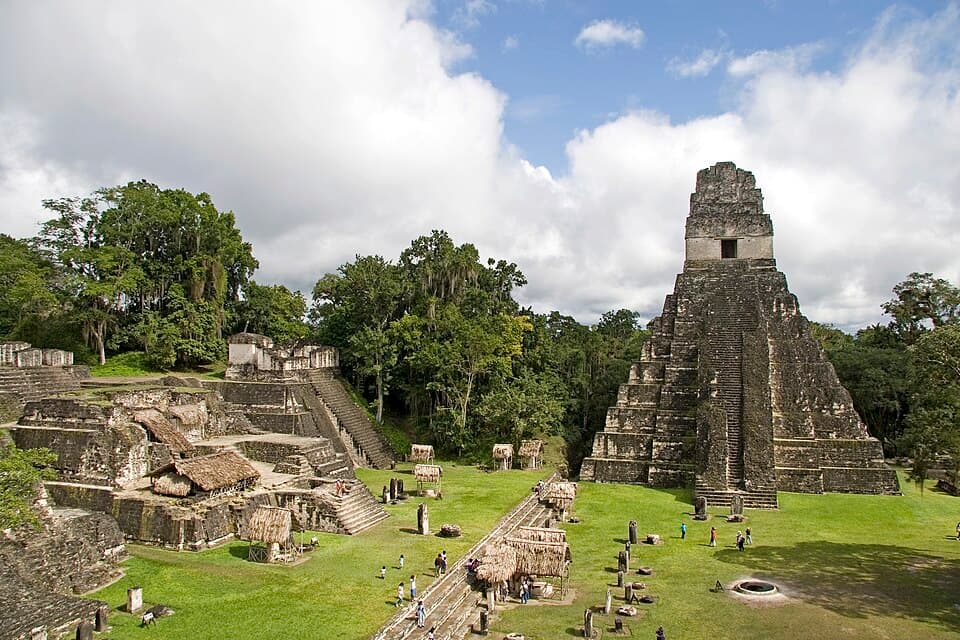
Tikal is the home of the Great Jaguar, the most powerful deity in the Maya cosmos. The jaguar embodied night, the underworld, shamanic power, and the cosmic night sky. Temple IV, the tallest structure at Tikal, was called the Temple of the Double-Headed Serpent or the Temple of the Great Jaguar — a place where the divine feline inhabited the sky and the underworld. The temple rises 65 meters (approximately 213 feet), making it one of the tallest structures built before the modern era by any pre-industrial civilization.
The complex temple system embodied the Maya cosmology: the pyramids served as axis mundi, connecting the terrestrial realm (middle), the celestial realm above, and Xibalba, the underworld below. Ritual bloodletting, human sacrifice, and the burning of offerings connected human action to the cosmic cycle. The stelae (carved stone monuments) and altars depicted the rulers' genealogies and connection to the gods, particularly Chaac (the rain god) and Itzamna (the creator and sky god).
Tikal was a rival of the great city Calakmul, and the two cities' competition drove Maya civilization to heights of artistic and architectural achievement.
Want more like this?
The Weekly Myth hasn't started yet: one sacred site a week, its myth and its history. Leave your email and we'll write when the first one goes out.
We'll only use your email for the Weekly Myth. Unsubscribe anytime.
Themes
The Place
Tikal sprawls across the Petén region of Guatemala in a rainforest setting. The main ceremonial complex covers roughly 6 square kilometers, with hundreds of structures dating from 600 BCE to 900 CE. The site is organized around plazas and pyramids: The Great Plaza, surrounded by pyramids and palaces; the Complex of Palaces and residential areas; Temple IV, the tallest; and Temple of the Great Jaguar (Temple I), 65 meters tall.
The structures are built on limestone bedrock, with stone platforms creating terraces and levels. Carved stelae (upright stone monuments) and altars throughout the complex depict kings, gods, and cosmic narratives. Intricate bas-relief carvings and hieroglyphic inscriptions cover many surfaces.
The rainforest setting is integral to Tikal's mystique. The jungle reclaims the structures slowly — massive tree roots penetrate stone, vines cover surfaces, and the dense vegetation creates a sense of archaeological romance. Wildlife (jaguars, pumas, ocelots, howler monkeys) inhabits the surrounding forest, preserving the ecological context of Maya civilization.
The History
Tikal was settled as early as 600 BCE and reached its apex between 200-900 CE during the Classic Maya period. The city was an economic, political, and religious center controlling regional trade and resources. The tallest temples were built around 700-800 CE, suggesting that the city's most confident period was its last before the collapse.
The Maya 'collapse' (c. 800-950 CE) remains controversial. Most scholars attribute it to a combination of factors: prolonged drought, deforestation, overpopulation, and social instability. The cities were not entirely abandoned — some population remained — but the complex civilization and monumental building ceased. Why such sophisticated cities would decline remains a cautionary tale about resource management and environmental limits.
Tikal was 'rediscovered' by Spanish conquistadors in the 16th century but remained largely unknown to the outside world until the 19th-century explorations. Modern excavation and conservation began in the mid-20th century. The site was designated a UNESCO World Heritage Site in 1979 and remains Guatemala's most famous archaeological site.
Frequently Asked
The largest Maya city, rising from the rainforest — temples 65 meters tall, home of the Great Jaguar and Complex cosmological narratives carved in stone.
Sources
Coe, Michael D.. Tikal: A Handbook of the Ancient Maya Ruins (1967). University of Pennsylvania Museum. The standard archaeological guide to Tikal's structures and history
Tier 1Diamond, Jared. Collapse: How Societies Choose to Fail or Succeed (2005). Viking. Discusses Maya collapse with Tikal as a case study in civilization decline
Tier 2Related Entries
Teotihuacan
The ancient city where the gods sacrificed themselves to create the Fifth Sun
State of Mexico, Mexico
Templo Mayor
The center of the Aztec universe — buried beneath Mexico City for 500 years, rediscovered by electrical workers in 1978
CDMX, Mexico
Mesa Verde — Ancestral Puebloan Cliff Dwellings
The cliff palaces of the Ancestral Puebloans, abandoned circa 1300 CE, central to Hopi and Pueblo origin narratives
Colorado, United States
Monte Alban — Zapotec City of the Clouds
The hilltop capital of the Zapotec civilization, occupied 500 BCE-700 CE, with an astronomical observatory and carved figures depicting captives and sacrificial victims
Oaxaca, Mexico
Mythic Grounds acknowledges that many sites documented here are sacred to Indigenous peoples and living cultural communities. We strive to present information respectfully, drawing only from published and authorized sources. If you are a member of a community represented on this site and believe any content is inaccurate or culturally inappropriate, please contact us.