 Wikimedia Commons
Historical: 5th century CERoyal Palace / FortressUNESCO World HeritageMythology
Sigiriya — Lion Rock Palace of the Parricide KingSinhalese Buddhist Mythology
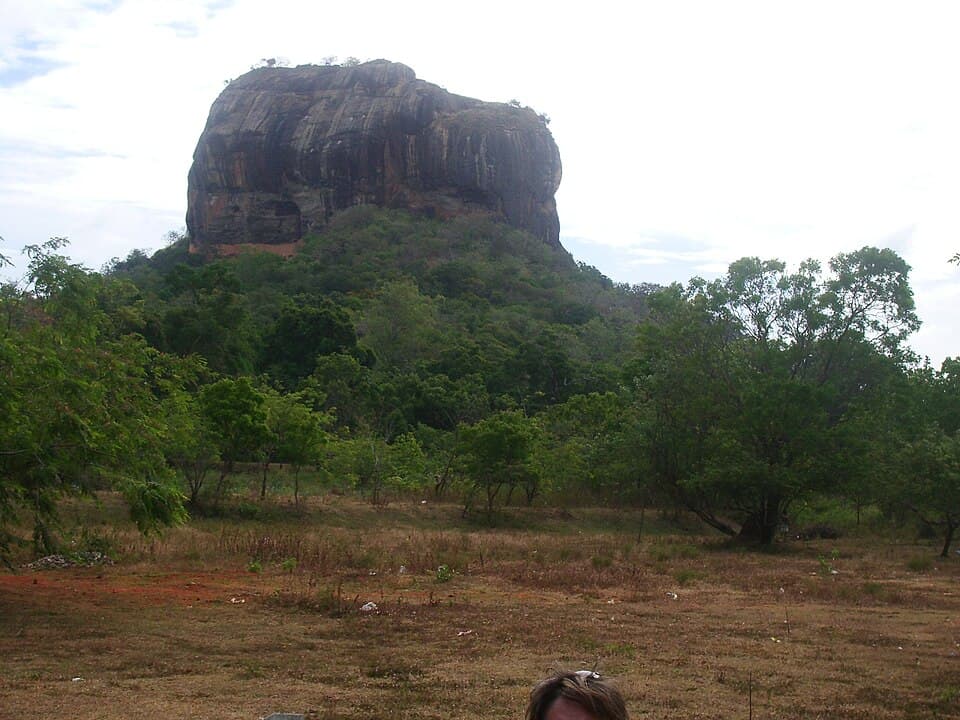
A 200-meter rock column crowned with palace ruins, built by a parricide king in the 5th century, decorated with frescoes and guarded by a giant lion-paw entrance
The Myth
Sigiriya is the fortress-palace of King Kashyapa I (5th century CE), a king infamous for murdering his own father to seize the throne. According to the Mahavamsa (the ancient Sinhalese chronicle), Kashyapa committed parricide to usurp his brother Moggallana's rightful inheritance. Consumed by guilt and fear of his brother's vengeance, Kashyapa fled to the wilderness and built a fortress on top of a 200-meter rock column — literally and symbolically elevating himself above ordinary law and morality.
The rock itself may have been regarded as sacred in pre-Kashyapa times — its isolated, towering form suggests a cosmic axis (axis mundi) connecting earth and heaven. The lion-paw gateway, carved into the rock face, represents the lion as a guardian figure and may reference a pre-existing cult of a lion deity. The palace itself was abandoned after Kashyapa was defeated in battle by his rightful heir. The site then became a Buddhist monastery, its association with the murderous king transformed into a meditation on karma, impermanence, and redemption.
Want more like this?
The Weekly Myth hasn't started yet: one sacred site a week, its myth and its history. Leave your email and we'll write when the first one goes out.
We'll only use your email for the Weekly Myth. Unsubscribe anytime.
Themes
The Place
Sigiriya rises abruptly from the Central Province landscape — a sheer 200-meter (655-foot) columnar rock formation with ruins perched on top. The entire rock is surrounded by ancient moated gardens and foundations of earlier structures. Visitors ascend via a spiral metal staircase path that follows the original route. Midway up, the lion-paw gateway remains — two massive stone paws that formed the base of a colossal lion statue. Frescoes of celestial maidens ('apsaras') adorn rock alcoves partway up, their pigments miraculously preserved over 1,500 years.
At the summit sit the ruins of Kashyapa's palace — foundations, walls, courtyards, and water cisterns. The palace was meticulously engineered with a sophisticated water management system, cisterns, and drainage. From the summit, views extend across the surrounding landscape for kilometers. The entire site is a UNESCO World Heritage Site and one of Sri Lanka's most photographed monuments.
The History
Sigiriya was built around 470-495 CE by King Kashyapa I as his fortress-capital. The construction represents remarkable engineering — carving and building on a sheer rock face required extraordinary skill and labor. The palace was occupied for less than a decade before Kashyapa's defeat and death. His brother Moggallana succeeded him, and Kashyapa's fortress was transformed into a Buddhist monastery, which functioned for about 1,000 years.
The site was largely abandoned by the 13th century CE and became overgrown and forgotten by the outside world. It was rediscovered by British colonial archaeologists in the 19th century and recognized as one of Asia's great archaeological treasures. Modern excavation has revealed sophisticated engineering, artistic sophistication, and complex social organization.
Sigiriya is now Sri Lanka's most visited archaeological site and one of the most recognizable monuments of ancient Asia. The combination of its architectural achievement, artistic decoration, legendary history, and dramatic landscape make it a UNESCO World Heritage Site and a UNESCO World Wonder.
Frequently Asked
A 200-meter rock column topped with 5th-century palace ruins, built by a parricide king and later converted to a Buddhist monastery, famed for its frescoes.
Sources
Weeraperuma, Susantha. Sigiriya: A Fortress in the Clouds (1994). Colombo Publishing House. Archaeological and historical study of Sigiriya's construction and significance
Tier 1Geiger, Wilhelm. The Mahavamsa: The Great Chronicle of Ceylon (Translated) (1912). Oxford University Press. Primary source chronicle documenting King Kashyapa I and the founding of Sigiriya
Tier 2Related Entries
Persepolis — Throne of Jamshid
The ceremonial capital of the Achaemenid Empire — known in Persian legend as the Throne of Jamshid, the mythological king who ruled for 700 years before his fall
Fars Province, Iran
Masada
Herod's mountaintop fortress overlooking the Dead Sea — site of the last stand of Jewish resistance against Rome, symbol of Jewish resilience and resolve
Dead Sea region, Israel
Tintagel Castle
The legendary birthplace of King Arthur on a dramatic Cornish clifftop — medieval ruin overlaying evidence of a 5th-6th century high-status settlement
Cornwall, United Kingdom
Mythic Grounds acknowledges that many sites documented here are sacred to Indigenous peoples and living cultural communities. We strive to present information respectfully, drawing only from published and authorized sources. If you are a member of a community represented on this site and believe any content is inaccurate or culturally inappropriate, please contact us.