 Wikimedia Commons
Dahomey Kingdom — c. 1600-1904 CEFolklore SiteUNESCO World HeritageMythology
Royal Palaces of AbomeyWest African (Ashanti / Dahomey / Igbo) Mythology
The palace complex of the Dahomey kings — where Vodun priests consecrated thrones with blood, and the Amazons of Dahomey drilled in the courtyards
Cultural sensitivity notice
Vodun is a living religion practiced by millions across West Africa and the African diaspora. The term 'voodoo' carries colonial and racist connotations. Visitors should approach Vodun sites and practices with the same respect given to any active religion.
Images via Wikimedia Commons
The Myth
The Kingdom of Dahomey (c. 1600-1904) was built on a foundation of Vodun — the indigenous spiritual system of the Fon people that would later, through the slave trade, give rise to Haitian Vodou and New Orleans Voodoo. The royal palaces of Abomey were not merely political centers but spiritual machines, designed to channel the power of the Vodun spirits (vodu) in service of the kingdom.
At the heart of Dahomean cosmology is the creator deity Mawu-Lisa — a dual-gendered divinity combining the female Mawu (moon, night, wisdom) and the male Lisa (sun, day, strength). Their children became the Vodun — Dan (the cosmic rainbow serpent), Sakpata (smallpox and disease), Hevioso (thunder), and Legba (the trickster guardian of crossroads). The serpent Dan is particularly central: depicted biting its own tail (resembling the ouroboros), Dan encircles the world, and the Dahomean kings claimed descent from the mating of a princess with a divine serpent.
Each king built his own palace within the compound, and each palace contained a shrine room where human sacrifices (the Annual Customs) honored deceased kings and strengthened the connection between the living and the dead. The bas-reliefs decorating palace walls depict the mythological charters of royal power.
Want more like this?
The Weekly Myth hasn't started yet: one sacred site a week, its myth and its history. Leave your email and we'll write when the first one goes out.
We'll only use your email for the Weekly Myth. Unsubscribe anytime.
Themes
The Place
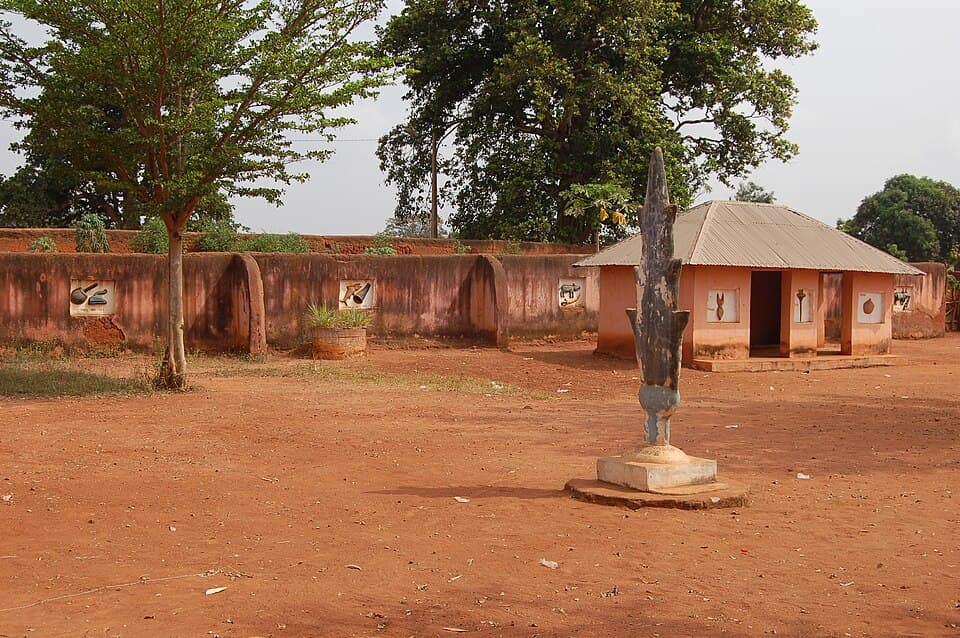
The Royal Palaces of Abomey occupy a 47-hectare site in the center of Abomey, the historic capital of the Dahomey kingdom, located approximately 135 kilometers north of Cotonou in south-central Benin. The complex includes the palaces of twelve successive kings, built between the mid-17th and late 19th centuries, arranged within a single walled compound.
The palaces are built of earth (adobe), with tall walls, thatched roofs, and decorated with polychrome bas-reliefs depicting royal exploits, mythological scenes, and proverbs. Each king adopted a unique symbol (the shark, the pineapple, the ship) that decorates his palace. The compound includes throne rooms, armories, the tombs of kings, and the quarters of the Mino (the all-female military regiment known in Europe as the 'Amazons of Dahomey'). The site is a UNESCO World Heritage Site (inscribed 1985).
The History
The Dahomey kingdom was founded in the early 17th century and grew into one of the most powerful states in West Africa, controlling a significant portion of the Atlantic slave trade through the port of Ouidah. The kingdom's wealth was built on a combination of warfare, tribute, and the sale of war captives to European slavers.
The Annual Customs — elaborate ceremonies involving human sacrifice — were the most controversial aspect of Dahomean practice, and their scale was exaggerated by European observers to justify colonial intervention. Modern scholars like J. Cameron Monroe and Edna Bay have reinterpreted the Customs as complex state rituals reinforcing the spiritual authority of the monarchy.
The Mino (female warriors) numbered 1,000-6,000 and fought with distinction in Dahomey's wars, including the final resistance against French colonial conquest in 1892-1894. King Béhanzin, the last independent ruler, was defeated by the French and exiled to Martinique. Before his defeat, he ordered much of the palace complex burned to prevent French looting. The palaces were partially restored and opened as a museum in 1944. Vodun practice continues throughout Benin; January 10 is National Vodun Day.
Frequently Asked
The palace complex of the Dahomey kings — where Vodun priests channeled divine power, serpent mythology legitimized royalty, and the legendary female warriors trained.
Sources
Bay, Edna G.. Wives of the Leopard: Gender, Politics, and Culture in the Kingdom of Dahomey (1998). University of Virginia Press. Revisionist study of Dahomean state religion, gender, and the role of Vodun in royal power
Tier 1Law, Robin. The Slave Coast of West Africa 1550-1750 (1991). Clarendon Press. History of the Slave Coast including Dahomey's rise and its intersection with the Atlantic slave trade
Tier 2Related Entries
Manhyia Palace & the Golden Stool
The seat of the Ashanti king and the shrine of the Golden Stool — Sika Dwa Kofi, the soul of the Ashanti nation, descended from heaven
Ashanti Region, Ghana
Arochukwu Long Juju Slave Route
The seat of the Ibini Ukpabi oracle — the 'Long Juju' of Arochukwu, the most powerful oracle in Igboland and a feared arbiter of justice for centuries
Abia State, Nigeria
Mothman Bridge
The Silver Bridge collapse and the Mothman sightings that preceded it
West Virginia, United States
Sleepy Hollow
The Dutch colonial village where Washington Irving's Headless Horseman rides — and where the real history is stranger than the fiction
New York, United States
Mythic Grounds acknowledges that many sites documented here are sacred to Indigenous peoples and living cultural communities. We strive to present information respectfully, drawing only from published and authorized sources. If you are a member of a community represented on this site and believe any content is inaccurate or culturally inappropriate, please contact us.