 Wikimedia Commons
Rapa Nui — c. 1200-1500 CE (major carving period)Rock Art SiteUNESCO World HeritageMythology
Ahu Tongariki & the Moai — Rapa NuiPolynesian Mythology
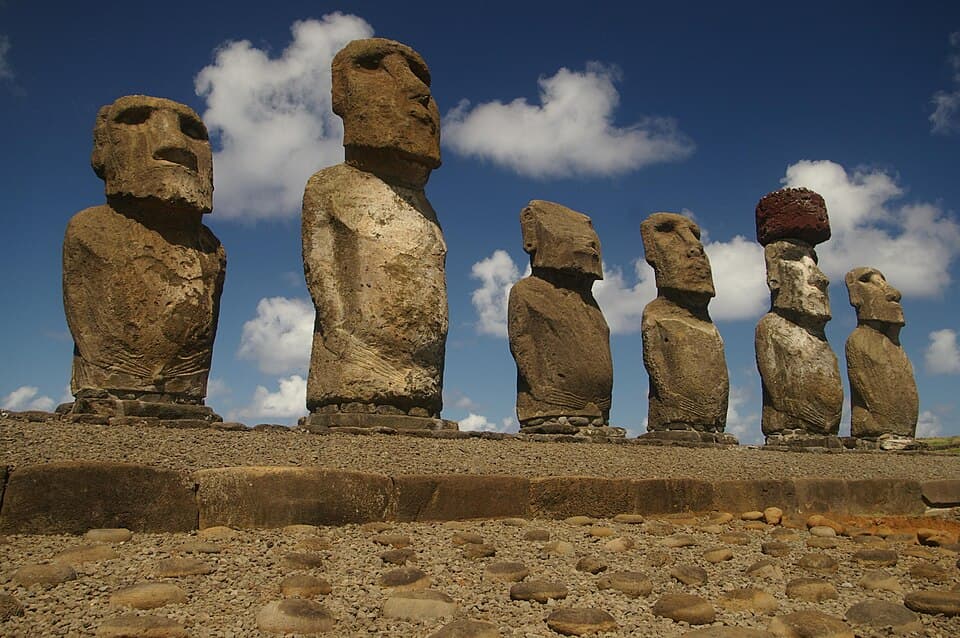
Monumental stone ancestors carved by the Rapa Nui people — 887 moai statues representing deified ancestors, with Ahu Tongariki the largest restored platform
The Myth
The moai are ancestors transformed into stone — a way of preserving the spiritual power and presence of the dead within the living community. Each moai, typically a male figure with exaggerated lips and strong chin, represents an important chief (ali'i) or ancestor. The statues faced inland, toward the village, watching over and protecting the communities of the living. The eyes, inlaid with white coral and black obsidian pupils, conveyed spiritual presence and intelligence.
According to Rapa Nui oral tradition, the ancestors arrived from distant lands (Hawaiki, a legendary homeland referenced across Polynesia). The supreme creator god Make-Make guided the peopling of the island. The landscape itself was sacred — the extinct volcanoes (Rano Raraku, Rano Kau) were places of power where new moai were carved and where stone was collected. Ahu Tongariki, restored in 1994-1996, is the most magnificent platform, with 15 restored moai facing the sea. The ahu platforms served dual purposes: as sites of ancestor veneration and as territorial markers defining the lands of different clans.
The moai were transported from the Rano Raraku quarry using a rocking-and-walking technique — teams of workers used ropes to tilt and pivot the statues forward along prepared roads, as demonstrated by archaeologists Terry Hunt and Carl Lipo. The largest moai weigh up to 80 tons, a testament to the engineering skill and coordinated labor of Rapa Nui society.
Want more like this?
The Weekly Myth hasn't started yet: one sacred site a week, its myth and its history. Leave your email and we'll write when the first one goes out.
We'll only use your email for the Weekly Myth. Unsubscribe anytime.
Themes
The Place
Rapa Nui (Easter Island) is the most isolated inhabited island on Earth, located 3,500 kilometers east of Chile in the South Pacific. The island is triangular, roughly 24 by 12 kilometers, with three major extinct volcanoes: Rano Kau, Rano Raraku, and Maunga Terevaka. The landscape is windswept, volcanic, with sparse vegetation adapted to salt spray and constant wind.
Ahu Tongariki sits on the eastern coast, a massive platform 139 meters long, raised on a base of large stones and backed by a stone wall. Fifteen moai stand on the platform, some over 8 meters tall, facing inland. The site overlooks the Pacific Ocean, with dramatic seascapes visible. Rano Raraku, on the opposite side of the island, is the quarry where nearly all moai were carved — a volcanic crater with hundreds of partially completed or abandoned statues still visible in the rock.
The landscape is covered with hundreds of ahu platforms and over 887 individual moai distributed around the island's perimeter. Each platform marks the territory and honored ancestors of a particular family lineage or clan. The density of ceremonial architecture on such a small island is extraordinary, suggesting a culture intensely focused on ancestor veneration and territorial marking.
The History
Rapa Nui was settled around 1200 CE by Polynesian voyagers, likely from the Marquesas or another central Pacific island. The population grew and flourished, developing the distinctive moai-carving tradition. The heaviest period of moai construction was approximately 1250-1500 CE, when hundreds of statues were carved and erected on platforms.
Around 1500 CE, the culture underwent a transformation. Moai construction abruptly ceased. Statues were toppled, platforms destroyed, and the society shifted from ancestor veneration focused on the ali'i (chiefs) to a warrior culture centered on the birdman cult (Birdman competition at Orongo crater). The reasons remain debated: environmental degradation, deforestation leading to resource scarcity, internal conflict, or population collapse from disease or other factors. By the time Europeans arrived (1722), the island's population had declined dramatically, and Polynesian settlement had been disrupted.
Ahu Tongariki was destroyed in the 1960 earthquake generated by a tsunami. Its restoration by Chilean and Japanese teams in 1994-1996 made it the most impressive ahu visible today. Modern Rapa Nui culture, blending indigenous heritage with Chilean governance, maintains strong connection to the moai and honors the ancestors they represent.
Frequently Asked
887 monumental stone moai representing ancestors, with Ahu Tongariki the largest restored platform — a Polynesian culture focused on honoring the dead.
Sources
Van Tilburg, Jo Anne. Easter Island: Archaeology, Ecology and Culture (1994). British Museum Press. Comprehensive study of moai carving, ahu construction, and Rapa Nui culture and environmental history
Tier 1Hunt, Terry & Lipo, Carl. The Statues That Walked: Unraveling the Mystery of Easter Island (2011). Free Press. Archaeological study demonstrating the 'walking' method of moai transport and reframing the Rapa Nui narrative away from ecological collapse
Tier 2Related Entries
Taputapuatea Marae
The most sacred marae in Polynesia — the international temple of the god Oro on Raiatea, from which all Polynesian voyaging traditions radiate
Leeward Islands, French Polynesia
Te Reinga (Cape Reinga)
The leaping-off place of spirits — where Maori souls depart the world of the living by sliding down a pohutukawa root into the underworld sea
Northland, New Zealand
Havai'i Nui (Mauna Kea)
The sacred summit of Hawai'i — meeting place of earth and sky, where the snow goddess Poliahu dwells and Hawaiian cultural identity confronts modern astronomy
Hawai'i, United States
Tassili n'Ajjer — Rock Art of the Spirits
A vast sandstone plateau in the Sahara preserving over 15,000 rock paintings spanning 10,000 years — depicting human figures, cattle, wildlife, and scenes interpreted as ritual or shamanic practice
Illizi Province, Algeria
Mythic Grounds acknowledges that many sites documented here are sacred to Indigenous peoples and living cultural communities. We strive to present information respectfully, drawing only from published and authorized sources. If you are a member of a community represented on this site and believe any content is inaccurate or culturally inappropriate, please contact us.