 Wikimedia Commons
8th century CE to presentTemple / RuinsMythology
Pura Besakih (Mother Temple of Bali)Southeast Asian Mythology
The holiest Hindu temple in Bali, perched on the slopes of Mount Agung — where the gods descend to Earth during ceremony
Cultural sensitivity notice
Pura Besakih is an active place of worship. Visitors should dress modestly, follow temple etiquette, and avoid entering inner sanctums during ceremonies unless invited. Women who are menstruating are traditionally asked not to enter temple grounds.
Images via Wikimedia Commons
The Myth
Pura Besakih is the spiritual center of Balinese Hinduism — the 'Mother Temple' (Pura Penataran Agung) from which all other temples on the island derive their spiritual authority. In Balinese cosmology, Mount Agung is the replica of Mount Meru, the cosmic axis, and the temple complex on its slopes is the place where heaven and earth meet. During major ceremonies, the gods are believed to physically descend from the summit to occupy the temple shrines.
The temple complex comprises 23 separate but related temples spread across the mountain's southwestern slope. The central trinity of shrines honors the Trimurti: Brahma (creator), Vishnu (preserver), and Shiva (destroyer). Balinese Hinduism, known locally as Agama Hindu Dharma, diverges significantly from Indian Hinduism — it integrates indigenous Balinese animism, ancestor worship, and a concept of cosmic balance (rwa bhineda) between opposing forces.
The 1963 eruption of Mount Agung, which killed over 1,000 people during a major purification ceremony (Eka Dasa Rudra), is interpreted in Balinese theology as a divine response to the ceremony being held at an inauspicious time due to political pressure from the Sukarno government. The ceremony was successfully completed in 1979.
Want more like this?
The Weekly Myth hasn't started yet: one sacred site a week, its myth and its history. Leave your email and we'll write when the first one goes out.
We'll only use your email for the Weekly Myth. Unsubscribe anytime.
Themes
The Place
Pura Besakih clings to the southwestern slopes of Mount Agung (3,031 meters), Bali's highest and holiest peak, at an elevation of approximately 1,000 meters. The complex covers roughly 8 hectares of terraced hillside, with the temples connected by stairways and courtyards that ascend the mountain in a series of ceremonial levels.
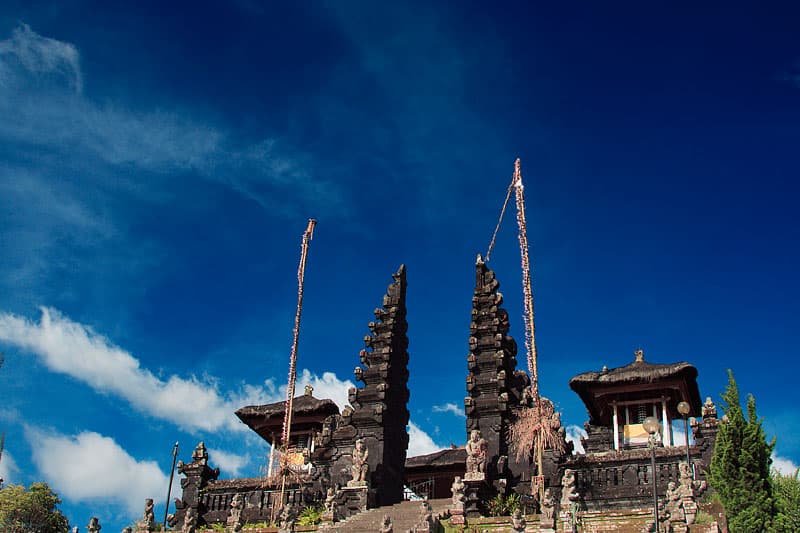
The setting is dramatic: the temple terraces rise through tropical vegetation with the volcanic cone of Agung towering above, often wreathed in cloud. On clear days, the views extend across much of Bali. The split gates (candi bentar), multi-tiered meru towers (pagoda-like shrines with odd-numbered tiers of thatched roofs), and carved stone walls exemplify classical Balinese temple architecture. The complex is surrounded by rice terraces and jungle.
The History
The site's sacred status predates recorded history, with archaeological evidence suggesting pre-Hindu megalithic worship. The earliest historical records date to the 8th century CE, when the temple served as a Hindu hermitage. The complex expanded significantly during the Gelgel dynasty (15th-17th centuries) and the subsequent Klungkung dynasty.
Balinese Hinduism itself is the product of the Hindu-Buddhist Majapahit Empire's influence on Bali beginning in the 14th century, layered over existing Balinese animist traditions. When Islam swept through Java in the 15th-16th centuries, Bali became a refuge for Hindu-Buddhist priests, nobles, and artists, preserving traditions that vanished from Java.
The 1963 eruption devastated surrounding villages but spared the temple complex itself — lava flows parted around the temple on both sides, which was interpreted as divine protection. Mount Agung erupted again in 2017-2018, again without destroying the temple. The complex was nominated for UNESCO World Heritage status but has not yet been inscribed, partly due to management concerns.
Frequently Asked
Bali's holiest temple, perched on the slopes of the sacred volcano Mount Agung — where the gods descend during ceremony in a living Hindu tradition.
Sources
Stuart-Fox, David. Pura Besakih: Temple, Religion and Society in Bali (2002). KITLV Press. Definitive English-language study of Besakih's temple complex and its role in Balinese Hinduism
Tier 2Picard, Michel. Balinese Religion in the Making: An Enquiry About the Interpretation of Agama Hindu as 'Hinduism' (chapter in The Appropriation of Religion in Southeast Asia and Beyond) (2017). Springer (ISBN 978-3-319-56230-8). View source → Updates the conceptual framing of Balinese Hindu identity that Besakih embodies. No verifiable Balinese-authored post-2015 monograph located; recommend manual Universitas Udayana / Jurnal Kajian Bali lookup.
Tier 2Related Entries
Angkor Wat
The largest religious monument on Earth — a stone model of the Hindu cosmos built by the Khmer Empire as the earthly Mount Meru
Siem Reap Province, Cambodia
Phnom Kulen
The sacred mountain where the Khmer Empire was born — home to the River of a Thousand Lingas and the birthplace of Angkorian civilization
Siem Reap Province, Cambodia
Naga Caves of the Mekong
The sacred stretch of the Mekong where the Naga king dwells beneath the river — source of the Naga Fireballs that rise from the water each October
Nong Khai Province, Thailand
Teotihuacan
The ancient city where the gods sacrificed themselves to create the Fifth Sun
State of Mexico, Mexico
Mythic Grounds acknowledges that many sites documented here are sacred to Indigenous peoples and living cultural communities. We strive to present information respectfully, drawing only from published and authorized sources. If you are a member of a community represented on this site and believe any content is inaccurate or culturally inappropriate, please contact us.