 Wikimedia Commons
Nabataean — 4th century BCE to 1st century CESacred CityUNESCO World HeritageMythology
Petra — The Rose-Red CityNabataean Mythology
The Nabataean rock-carved city in the desert, home of the Treasury and Monastery — one of the New 7 Wonders, a testament to water engineering and desert wisdom
The Myth
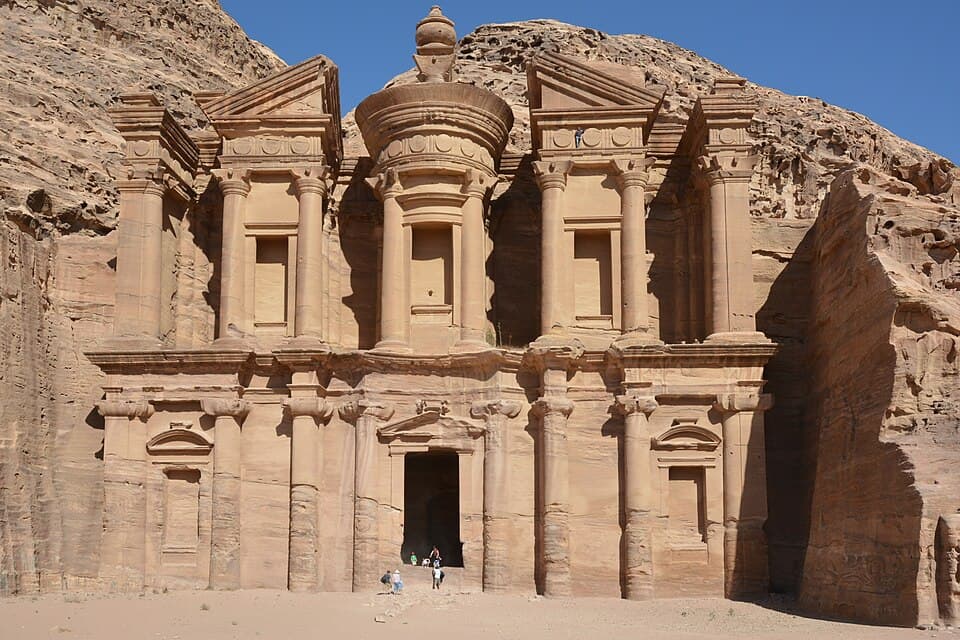
Petra is the rose-red city, a place where human ambition carved divinity directly into mountain stone. The Nabataeans, a Semitic people, created a sacred landscape honoring Dushara ('Lord of Shara'), the chief deity, and Al-Uzza, a pre-Islamic Arabian goddess of vegetation and fertility. The carved facades, especially the Treasury (Al-Khazneh) with its intricate Hellenistic and Near Eastern decorative elements, suggest temples or royal tombs where the boundary between the divine and human worlds was ritually enacted.
The Siq, a 1.2-kilometer gorge with walls rising 80 meters, served as a processional passage where merchants and pilgrims entered the sacred precinct. Water channels carved into the rock suggest ritual ablutions and the precious role of water in the desert — water itself was sacred. The Nabataeans' legendary water engineering, including dams, cisterns, and channels that captured rare rainfall, made the desert flower and made Petra an oasis of civilization.
Petra was not merely a city but a sacred geography, a place where the gods were believed to dwell in the stone itself.
Want more like this?
The Weekly Myth hasn't started yet: one sacred site a week, its myth and its history. Leave your email and we'll write when the first one goes out.
We'll only use your email for the Weekly Myth. Unsubscribe anytime.
Themes
The Place
Petra sits in the Shara Mountains of southern Jordan, surrounded by sandstone cliffs of extraordinary colors — reds, purples, oranges, and whites. The site covers 264 square kilometers, with major structures concentrated in a 15-square-kilometer area. The most famous structure, the Treasury (Al-Khazneh), is 40 meters high and 25 meters wide, carved from a single cliff face in the Hellenistic style with ornamental urns, columns, and a central tholos (circular temple).
The Monastery (Ad Deir), the largest of Petra's carved monuments, is 50 meters high and 45 meters wide, accessible by a staircase carved into the rock. Between these are hundreds of other structures: temples, residences, storage chambers, and tombs. Channels carved into the rock guide water to cisterns and baths. The Nabataean Quarters preserve houses and streets. The High Place of Sacrifice offers panoramic views of the entire complex.
The city sprawls across terrain that required expert navigation and water management. Visitors traverse the Siq, cross the Outer Siq, and emerge into a landscape of carved wonder.
The History
Petra was established around the 4th century BCE as the Nabataean capital and a crucial junction on the incense trade routes connecting Arabia, the Mediterranean, and India. The Nabataeans grew wealthy through control of these routes and through their mastery of desert survival and commerce. Major construction occurred under Aretas IV (9 BCE-40 CE), when the Treasury and major temples were likely carved.
In 106 CE, Rome annexed the Nabataean kingdom, and Petra became part of the Roman province of Arabia Petraea. The city declined as trade routes shifted, particularly after the sea route around Africa became commercially viable. By the Islamic period, Petra was abandoned and lost to Western knowledge.
The Swiss explorer Johann Burckhardt, traveling in disguise as a Muslim pilgrim, 'rediscovered' Petra in 1812, bringing it to international attention. The city was designated a UNESCO World Heritage Site in 1985 and named one of the New 7 Wonders in 2007. Modern conservation efforts address rock stability, water erosion, and visitor management.
Frequently Asked
The rose-red Nabataean city carved into desert cliffs, home of the iconic Treasury and Monastery — a New 7 Wonder showcasing desert wisdom and religious artistry.
Sources
Al-Maqdissi, Mahmoud. Petra: The Nabataean Gem of Jordan (2005). UNESCO Publications. Comprehensive study of Petra's architecture, water systems, and cultural significance
Tier 1Bowsher, Julian. The Petra Excavation: Architecture and Stratigraphy (2010). Council for British Research in the Levant. Archaeological excavation results from recent Petra investigations
Tier 2Related Entries
Uruk — City of Gilgamesh
The world's first great city and the setting of the oldest story ever written — where Gilgamesh built his walls and sought immortality
Muthanna Governorate, Iraq
Babylon — City of Marduk
The seat of Marduk, king of the Babylonian gods — home of the Ishtar Gate, the Hanging Gardens, and the tower the Bible called Babel
Babil Governorate, Iraq
Nineveh — City of Ishtar
The great Assyrian capital where the Library of Ashurbanipal preserved the Epic of Gilgamesh — and where Ishtar was worshipped for 6,000 years
Nineveh Governorate, Iraq
Varanasi — City of Shiva
The oldest continuously inhabited city in the world and the holiest site in Hinduism — where Shiva dwells eternally and the Ganges washes away all sin
Uttar Pradesh, India
Mythic Grounds acknowledges that many sites documented here are sacred to Indigenous peoples and living cultural communities. We strive to present information respectfully, drawing only from published and authorized sources. If you are a member of a community represented on this site and believe any content is inaccurate or culturally inappropriate, please contact us.