 Wikimedia Commons
Deep past through Seminole Wars era; ongoingFolklore SiteMythology
Okefenokee Swamp — Trembling EarthSoutheast Nations Mythology
The vast peat swamp whose Creek/Muscogee name means 'Land of Trembling Earth' — home to swamp spirits and will-o'-wisps
Images via Wikimedia Commons
The Myth
The Okefenokee's name comes from the Creek (Muscogee) words meaning 'Land of Trembling Earth,' referring to the floating peat islands that shake underfoot — ground that is not quite solid, a landscape between land and water. In Creek and Seminole oral traditions, the swamp is home to spiritual beings and trickster figures who inhabit the borderlands between the seen and unseen worlds.
Will-o'-wisps — flickering lights seen over the swamp at night — feature in both Indigenous and later settler folklore of the region. In Creek tradition, these lights could be the manifestations of spirits or warnings from the spirit world. European settlers brought their own interpretations: ghost lights, fairy fires, or the lanterns of the dead. The scientific explanation — bioluminescence or spontaneous combustion of swamp gases (methane and phosphine) — has never fully accounted for all reported sightings, and the mystery persists.
The Seminole people, who entered the swamp in the 18th and 19th centuries while fleeing American military campaigns, added their own layer of spiritual geography. The Okefenokee became a refuge — a place so forbidding that the US Army could not follow. The swamp's resistance to human control became part of its mythic identity: this is land that refuses to be tamed, that literally shakes off the weight of those who try to walk on it.
Want more like this?
The Weekly Myth hasn't started yet: one sacred site a week, its myth and its history. Leave your email and we'll write when the first one goes out.
We'll only use your email for the Weekly Myth. Unsubscribe anytime.
Themes
The Place
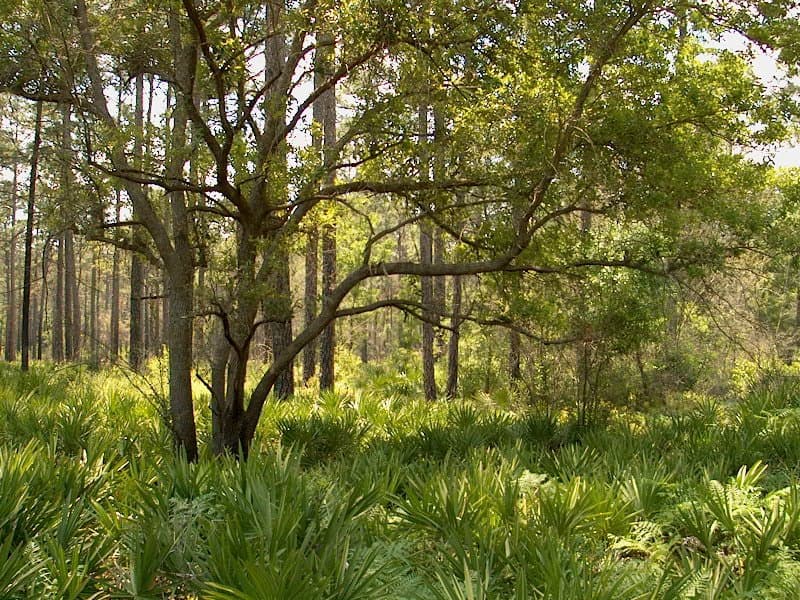
The Okefenokee Swamp covers approximately 438,000 acres (roughly 700 square miles) in southeastern Georgia and northeastern Florida. It is one of the largest intact freshwater wetland ecosystems in North America. The swamp is characterized by floating peat mats (called 'batteries'), cypress forests, open prairies of aquatic plants, and blackwater channels. The water is stained dark by tannins from decomposing vegetation, giving it the appearance of strong tea.
The Okefenokee National Wildlife Refuge protects most of the swamp. Access is limited to designated entry points: the eastern entrance at Suwannee Canal Recreation Area, the western entrance at Stephen C. Foster State Park, and the northern entrance at the Okefenokee Swamp Park. Boat trails and elevated boardwalks provide access to the interior.
The History
Creek and Seminole peoples inhabited and used the Okefenokee for centuries. John R. Swanton's 'Myths and Tales of the Southeastern Indians' (Bureau of American Ethnology, 1929) collected oral traditions from Creek, Hitchiti, Alabama, Koasati, and Natchez peoples, providing primary source material for the mythological traditions of the region. Swanton documented animal trickster stories, origin narratives, and accounts of spiritual beings associated with waterways and swamps.
The Okefenokee was the site of military operations during the Seminole Wars, as Seminole bands used the swamp as a refuge. Logging operations in the early 20th century threatened the swamp before conservation efforts led to the establishment of the wildlife refuge in 1937. Recent proposals for mining operations near the swamp's boundary have generated ongoing environmental and cultural controversy.
Frequently Asked
The vast swamp whose Creek name means 'Land of Trembling Earth' — a landscape between land and water, home to will-o'-wisps and spirit beings in Southeastern Indigenous tradition.
Sources
Swanton, John R.. Myths and Tales of the Southeastern Indians (1929). Bureau of American Ethnology, Bulletin 88. Primary source for Creek, Hitchiti, Alabama, Koasati, and Natchez oral traditions
Tier 1Related Entries
Mothman Bridge
The Silver Bridge collapse and the Mothman sightings that preceded it
West Virginia, United States
Sleepy Hollow
The Dutch colonial village where Washington Irving's Headless Horseman rides — and where the real history is stranger than the fiction
New York, United States
Roanoke Island
The colony that vanished in 1590, leaving only the word CROATOAN carved into a post — America's oldest unsolved mystery
North Carolina, United States
The Jersey Devil Birthplace
The Pine Barrens homestead where Mother Leeds gave birth to her 13th child — and it flew up the chimney
New Jersey, United States
Mythic Grounds acknowledges that many sites documented here are sacred to Indigenous peoples and living cultural communities. We strive to present information respectfully, drawing only from published and authorized sources. If you are a member of a community represented on this site and believe any content is inaccurate or culturally inappropriate, please contact us.