 Wikimedia Commons
The age of the Olympian gods — ongoing in Greek literary traditionSacred MountainUNESCO World HeritageMythology
Mount OlympusAncient Greek Mythology
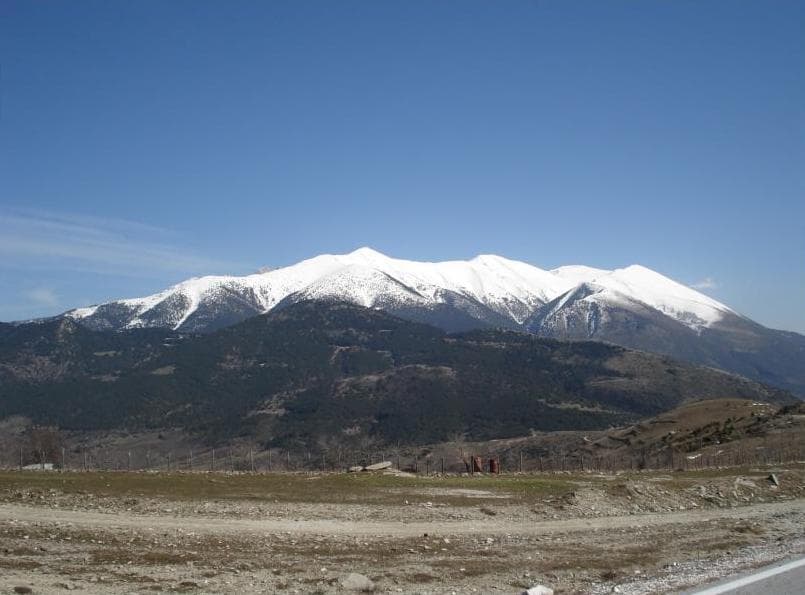
The highest peak in Greece and the mythological seat of the twelve Olympian gods — where Zeus held court above the clouds
Images via Wikimedia Commons
The Myth
Mount Olympus was the dwelling place of the twelve Olympian gods in Greek mythology. Zeus, king of the gods, held court on the summit, which was said to be above the clouds and the weather — a place of eternal light, neither too hot nor too cold. Homer describes it in the Odyssey: 'Neither is it shaken by winds nor ever wet with rain, nor does snow fall upon it, but the air is outspread clear and cloudless, and over it hovers a radiant whiteness.'
The gods lived in palaces built by Hephaestus, the divine craftsman. They feasted on ambrosia and nectar, discussed the fate of mortals, intervened in wars, fell in love, schemed against each other, and occasionally descended to the world below in disguise. The mountain was not merely the gods' address — it was the axis of the Greek cosmos, the point where the divine and mortal worlds were closest.
The Gigantomachy — the battle between the Olympian gods and the Giants — was fought on and around the mountain. The Titans, defeated earlier, were imprisoned in Tartarus beneath the earth. Olympus stood as the triumphant seat of the current divine order.
Want more like this?
The Weekly Myth hasn't started yet: one sacred site a week, its myth and its history. Leave your email and we'll write when the first one goes out.
We'll only use your email for the Weekly Myth. Unsubscribe anytime.
Themes
The Place
Mount Olympus is the highest mountain in Greece, its summit Mytikas reaching 9,573 feet. Located in northeastern Greece on the border of Pieria and Thessaly, roughly 60 miles from Thessaloniki, it rises dramatically from near sea level to alpine peaks in just 11 miles.
The mountain is home to over 1,700 plant species, including many endemics. The Enipeas Gorge on the eastern flank is one of the deepest canyons in Europe. Olympus National Park, established in 1938, was Greece's first national park. The summit can be reached on foot in two days from the village of Litochoro, with a refuge hut at Spilios Agapitos (6,890 ft).
The History
Olympus has been a sacred mountain since at least the Mycenaean period (c. 1600-1100 BCE). The cult of Zeus on Olympus predates the literary sources — Homer and Hesiod (8th-7th century BCE) inherited a tradition already ancient in their time.
Archaeological remains of a sanctuary of Zeus have been found at Agios Antonios, near the summit plateau. The mountain's inaccessibility reinforced its mythological status — the summit was not reached by recorded climbers until 1913, when Christos Kakkalos, a local shepherd, guided the Swiss mountaineers Frederic Boissonnas and Daniel Baud-Bovy to the top. The first ascent of the true summit, Mytikas, was made by Kakkalos alone shortly after.
Mythological Connections
Frequently Asked
The highest peak in Greece and the mythological seat of the twelve Olympian gods — where Zeus held court above the clouds in a place of eternal light.
Sources
Myers, Tobias. Homer's Divine Audience: The Iliad's Reception on Mount Olympus (2019). Oxford University Press. View source → Peer-reviewed monograph reading the Olympian gods as Homer's internal audience; central to recent scholarship on Mount Olympus in Greek religious imagination.
Tier 2Homer; trans. Emily Wilson. The Iliad (2023). W. W. Norton & Company. View source → Major new translation by a leading classicist, now the contemporary standard alongside her 2018 Odyssey; offers a fresh modern English rendering of Olympian scenes.
Tier 3Homer (trans. Lattimore, Richmond). The Iliad / The Odyssey (1951). University of Chicago Press. View source → Primary source for the Olympian gods; Lattimore translation is standard scholarly edition
Tier 1Collections
Related Entries
Ile-Ife — Sacred City of Creation
The holy city where the Yoruba believe the world was created — where Oduduwa descended from heaven on a chain and scattered sand upon the primordial waters
Osun State, Nigeria
Knossos — Palace of the Minotaur
The Bronze Age palace on Crete that may have inspired the myth of the Labyrinth — where Theseus slew the Minotaur in the halls of King Minos
Crete, Greece
Diktaean Cave — Birthplace of Zeus
The cave on Crete where Rhea hid the infant Zeus from his father Kronos — the birthplace of the king of the gods
Crete, Greece
Troy (Hisarlik)
The legendary site of the Trojan War — archaeologically verified through multiple city layers, hero of Homer's Iliad, home of Priam and Hector
Çanakkale Province, Turkey
Mythic Grounds acknowledges that many sites documented here are sacred to Indigenous peoples and living cultural communities. We strive to present information respectfully, drawing only from published and authorized sources. If you are a member of a community represented on this site and believe any content is inaccurate or culturally inappropriate, please contact us.