 Wikimedia Commons
Kikuyu oral tradition — ongoingSacred MountainUNESCO World HeritageMythology
Mount Kenya (Kirinyaga)East African Mythology
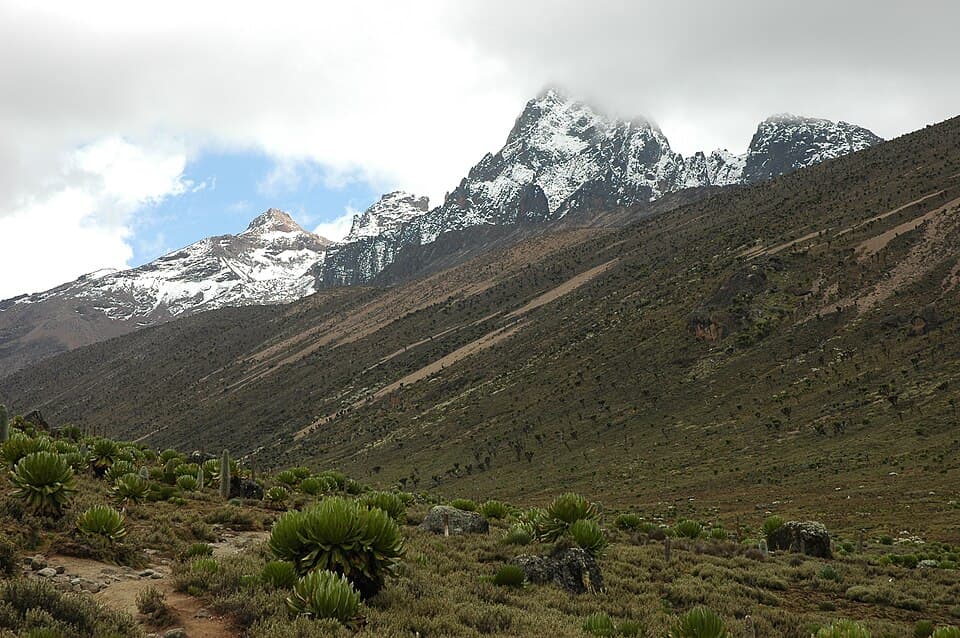
The Mountain of Brightness — seat of the Kikuyu creator god Ngai, toward which all prayers are directed and from which the first man and woman descended
Cultural sensitivity notice
Mount Kenya remains a sacred site for the Kikuyu, Embu, and Meru peoples. Trekkers should be respectful of any prayer sites or ritual markers encountered on the mountain. The loss of glaciers due to climate change is a spiritual as well as environmental concern for local communities.
Images via Wikimedia Commons
The Myth
Mount Kenya — Kirinyaga ('Mountain of Brightness' or 'Mountain of the Ostrich') in Kikuyu — is the earthly dwelling place of Ngai (Mwene Nyaga), the supreme creator god of the Kikuyu, Embu, and Meru peoples. In Kikuyu cosmology, Ngai created the first man, Gikuyu, and placed him on the slopes of Kirinyaga, showing him all the land spread before him. Ngai then created Mumbi, the first woman, and together they became the ancestors of the nine Kikuyu clans.
All traditional Kikuyu prayer is directed toward the mountain. Homes were traditionally built with doors facing Kirinyaga. When the Kikuyu prayed, they raised their hands toward the glacial peaks, addressing Ngai in his mountain abode. The mountain was not merely a symbol but the literal connection point between the human world and the divine.
The snow-capped peaks were understood as Ngai's throne, and the mountain's weather — the gathering of clouds, the release of rain, the thunder that rolled down its slopes — was the direct expression of divine will. The forests on the mountain's lower slopes were sacred, inhabited by spirits, and entering them required ritual preparation.
Want more like this?
The Weekly Myth hasn't started yet: one sacred site a week, its myth and its history. Leave your email and we'll write when the first one goes out.
We'll only use your email for the Weekly Myth. Unsubscribe anytime.
Themes
The Place
Mount Kenya is an extinct stratovolcano rising to 5,199 meters (Batian Peak), making it Africa's second-highest mountain after Kilimanjaro. The mountain straddles the equator in central Kenya, its glaciated peaks visible from over 100 kilometers away. The mountain is surrounded by dense montane forest, bamboo zones, moorland, and finally the alpine zone with its bizarre giant lobelias and groundsels.
Mount Kenya National Park and Natural Forest cover 2,023 square kilometers and are a UNESCO World Heritage Site. The mountain feeds multiple river systems that provide water to millions. The Lewis Glacier and other remnant glaciers are retreating rapidly due to climate change — within decades, the mountain will lose all its ice, altering its appearance and spiritual resonance.
The History
The Kikuyu, Embu, and Meru peoples have lived on the slopes of Mount Kenya for centuries. European 'discovery' came in 1849 when German missionary Johann Ludwig Krapf reported the snow-capped peak from a distance — his account was ridiculed in Europe, as equatorial snow seemed impossible. The first European ascent was in 1899 by Halford Mackinder.
During the colonial period, British land seizures displaced many Kikuyu from the mountain's fertile slopes, fueling the Mau Mau uprising (1952-1960) — guerrilla fighters hid in the mountain's forests, and the conflict centered on the land dispossession that Kikuyu spiritual tradition made doubly painful. Jomo Kenyatta, Kenya's first president, was a Kikuyu who wrote 'Facing Mount Kenya' (1938), an anthropological study of Kikuyu culture that emphasized the mountain's centrality to Kikuyu identity.
Today, traditional Kikuyu practices continue alongside Christianity. Elders still pray facing the mountain. The Mount Kenya region produces much of Kenya's tea and coffee, and the mountain's water resources are critical to the national economy.
Frequently Asked
The Mountain of Brightness — seat of the Kikuyu creator god Ngai, toward which all traditional prayers are directed and from which the first humans descended.
Sources
Kenyatta, Jomo. Facing Mount Kenya: The Tribal Life of the Gikuyu (1938). Secker and Warburg. Foundational ethnographic study by Kenya's first president describing Kikuyu culture and Kirinyaga's sacred status
Tier 1Muriuki, Godfrey. A History of the Kikuyu, 1500-1900 (1974). Oxford University Press. Historical study of the Kikuyu including their spiritual relationship with Mount Kenya
Tier 2Collections
Related Entries
Mount Shasta
The volcanic peak where the sky spirit Skell made his home among the Klamath, Modoc, Wintu, and Achumawi peoples
California, United States
Dine Tah — Navajo Sacred Mountains
The four sacred mountains that mark the boundaries of the Navajo homeland
Arizona/New Mexico/Colorado, United States
Shiprock
The volcanic neck the Navajo call Tse Bit'a'i — the rock with wings — where the people were carried to safety on the back of a great bird
New Mexico, United States
Spider Rock
The 800-foot sandstone spire in Canyon de Chelly where Spider Woman taught the Navajo to weave
Arizona, United States
Mythic Grounds acknowledges that many sites documented here are sacred to Indigenous peoples and living cultural communities. We strive to present information respectfully, drawing only from published and authorized sources. If you are a member of a community represented on this site and believe any content is inaccurate or culturally inappropriate, please contact us.