 Wikimedia Commons
Mythological: heroic age; Historical: c. 1700-1375 BCETemple / RuinsUNESCO World HeritageMythology
Knossos — Palace of the MinotaurAncient Greek Mythology
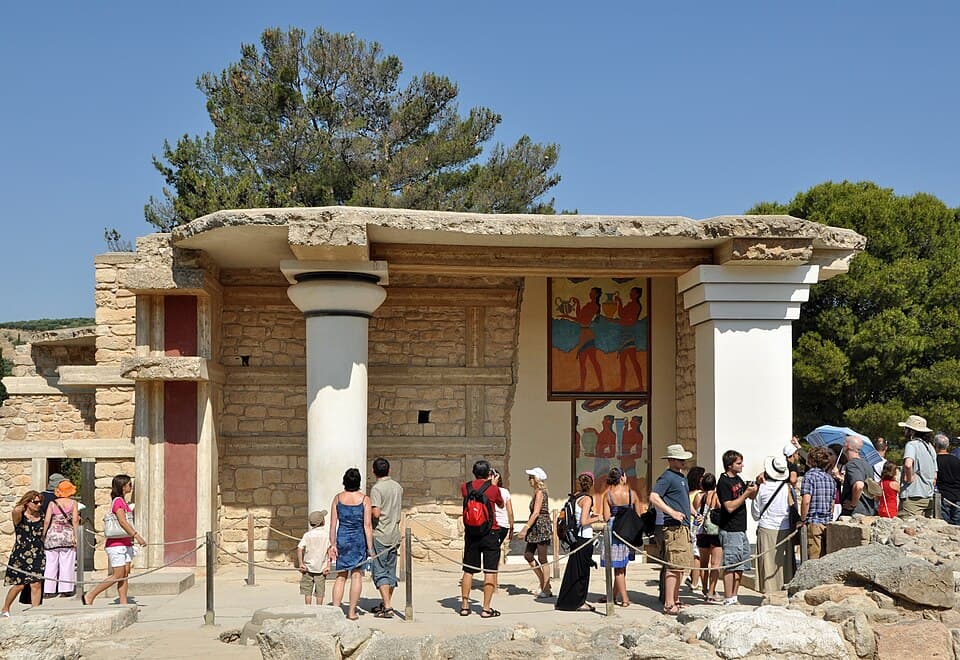
The Bronze Age palace on Crete that may have inspired the myth of the Labyrinth — where Theseus slew the Minotaur in the halls of King Minos
Images via Wikimedia Commons
The Myth
In Greek mythology, King Minos of Crete commissioned the master craftsman Daedalus to build the Labyrinth — a structure so complex that no one who entered could find their way out. At its center lived the Minotaur, a creature half man and half bull, born from the union of Minos' wife Pasiphae and a sacred bull sent by Poseidon.
Every nine years, Athens was forced to send seven young men and seven young women as tribute to be devoured by the Minotaur. The Athenian hero Theseus volunteered as one of the fourteen, entered the Labyrinth, slew the Minotaur, and escaped by following a thread given to him by Minos' daughter Ariadne.
The myth encodes real cultural memory: Minoan Crete was the dominant naval power of the Aegean, and bull imagery pervaded Minoan art and ritual. The 'bull-leaping' frescoes of Knossos depict a dangerous ritual that may lie behind the Minotaur legend. The labyrinthine complexity of the palace itself — over 1,000 rooms on multiple levels — could easily have seemed impossible to navigate to Bronze Age visitors.
Want more like this?
The Weekly Myth hasn't started yet: one sacred site a week, its myth and its history. Leave your email and we'll write when the first one goes out.
We'll only use your email for the Weekly Myth. Unsubscribe anytime.
Themes
The Place
Knossos lies 3 miles south of the modern city of Heraklion on Crete's north coast. The palace complex covers roughly 6 acres and was the ceremonial and administrative center of Minoan civilization — the first advanced civilization in Europe.
The ruins include the Throne Room (with the oldest throne in Europe, still in place), the Grand Staircase, elaborate drainage systems, and vivid frescoes depicting dolphins, bull-leaping, and the 'Prince of the Lilies.' Sir Arthur Evans' controversial reconstructions — painted concrete restorations of portions of the palace — are debated by archaeologists but give visitors a vivid sense of the original scale and color.
The History
Knossos was occupied from the Neolithic period (c. 7000 BCE) and reached its peak as a Minoan palace complex around 1700-1450 BCE. The palace was destroyed and rebuilt multiple times, likely by earthquakes. Its final destruction around 1375 BCE may be connected to the Mycenaean takeover of Crete.
Sir Arthur Evans excavated the site beginning in 1900 and spent 35 years and much of his personal fortune on the work. He named the civilization 'Minoan' after King Minos. The Linear B tablets found at Knossos were deciphered by Michael Ventris in 1952, revealing them to be an early form of Greek — proving that Mycenaean Greeks had occupied the palace in its final phase.
Whether the 'Labyrinth' was the palace itself, a specific wing, or the nearby Gortyn cave system remains debated. The word 'labyrinth' may derive from labrys, the double-headed axe that was a central Minoan religious symbol.
Mythological Connections
Frequently Asked
The Bronze Age palace on Crete whose 1,000-room complexity may have inspired the myth of the Labyrinth — where Theseus slew the Minotaur at the heart of King Minos' maze.
Sources
Whitley, James. Knossos: Myth, History and Archaeology (2023). Bloomsbury Academic (Archaeological Histories). View source → Single-author 2023 synthesis spanning legend through archaeology; reviewed in BMCR 2024.10.20. Adds a fresh framing post-2022 sources don't carry.
Tier 2Castleden, Rodney. Minotaur: Sir Arthur Evans and the Archaeology of the Minoan Myth (1990). Routledge. View source → Critical examination of how Evans' excavation shaped and was shaped by the Minotaur myth
Tier 2Schoep, Ilse, Peter Tomkins and Jan Driessen (eds.). Back to the Beginning: Reassessing Social and Political Complexity on Crete during the Early and Middle Bronze Age (2012). Oxbow Books, Oxford. Major revisionist volume reconsidering the 'palace' label and the chronology of Knossos's emergence. Includes Tomkins's reassessment of the First Palace at Knossos. Replaces older Evans-derived narratives.
Tier 2Driessen, Jan. The Central Court of the Palace at Knossos (2002). in *Monuments of Minos: Rethinking the Minoan Palaces*, ed. Jan Driessen et al., Aegaeum 23, Université de Liège. Driessen's reading of the Central Court as the essence of the Minoan 'palace' — an architectural representation of the Cretan landscape rather than a royal seat in the Near Eastern sense.
Tier 2Schoep, Ilse. The Minoan 'Palace-Temple' Reconsidered: A Critical Reassessment of the Spatial Concentration of Political, Religious and Economic Power in Bronze Age Crete (2010). Journal of Mediterranean Archaeology, vol. 23, no. 2. Schoep's challenge to the long-standing Evans/Renfrew model of Knossos as a palace-temple of concentrated power.
Tier 2Letesson, Quentin and Carl Knappett (eds.). Minoan Architecture and Urbanism: New Perspectives on an Ancient Built Environment (2017). Oxford University Press. View source → Edited volume from a 2015 Toronto workshop; reframes Minoan 'palaces' through spatial/architectural analysis, includes a Driessen chapter. Extends the Schoep/Tomkins/Driessen 2012 line.
Tier 2Hamilakis, Yannis and Raphael Greenberg. Archaeology, Nation, and Race: Confronting the Past, Decolonizing the Future in Greece and Israel (2022). Cambridge University Press. View source → Hamilakis's most recent statement on the colonial construction of 'the Minoans'; useful for HV reframing of how Knossos has been narrated since Evans.
Tier 2Related Entries
Mount Olympus
The highest peak in Greece and the mythological seat of the twelve Olympian gods — where Zeus held court above the clouds
Pieria / Thessaly, Greece
Delphi — Oracle of Apollo
The navel of the world — where the Pythia spoke prophecy over a chasm, and kings and generals sought divine counsel for a thousand years
Phocis, Greece
Troy (Hisarlik)
The legendary site of the Trojan War — archaeologically verified through multiple city layers, hero of Homer's Iliad, home of Priam and Hector
Çanakkale Province, Turkey
Teotihuacan
The ancient city where the gods sacrificed themselves to create the Fifth Sun
State of Mexico, Mexico
Mythic Grounds acknowledges that many sites documented here are sacred to Indigenous peoples and living cultural communities. We strive to present information respectfully, drawing only from published and authorized sources. If you are a member of a community represented on this site and believe any content is inaccurate or culturally inappropriate, please contact us.