 Wikimedia Commons
Tjukurpa (Dreamtime) — the eternal creative presentSacred MountainUNESCO World HeritageLiving tradition
Kata Tjuta — Abode of the WanambiAboriginal Australian Mythology
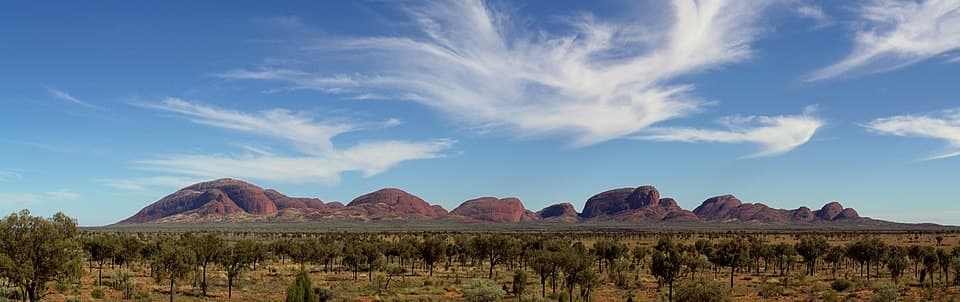
The 36 domed rock formations west of Uluru — dwelling place of the great serpent Wanambi, whose breath is the wind that funnels through the Valley of the Winds
Cultural sensitivity notice
Much of the Tjukurpa associated with Kata Tjuta relates to men's ceremonial business and is strictly restricted. The Anangu have asked that this restriction be respected. This page presents only information authorized for public sharing. Aboriginal and Torres Strait Islander peoples should be aware that this page contains names and descriptions of cultural significance.
Images via Wikimedia Commons
The Myth
Kata Tjuta ('many heads' in Pitjantjatjara) is a place of immense sacred significance to the Anangu, much of which is restricted knowledge not shared with outsiders. What is publicly known is that the great serpent Wanambi lives in the waterhole on top of Mount Olga, the highest dome, and that his breath is the wind that blows through the gorges and valleys between the rock formations.
The Wanambi is a powerful and dangerous being — a Rainbow Serpent figure similar to those found across Aboriginal Australian traditions, connecting water, fertility, and cosmic power. The wind that funnels through the Valley of the Winds is understood as the serpent's living presence.
Much of the Tjukurpa (Dreamtime law) associated with Kata Tjuta relates to men's ceremonial business and is therefore restricted — it cannot be shared publicly, and the Anangu have asked that this restriction be respected. The visible landscape at Kata Tjuta is understood to be the surface expression of deeper sacred realities that are not for public consumption.
Want more like this?
The Weekly Myth hasn't started yet: one sacred site a week, its myth and its history. Leave your email and we'll write when the first one goes out.
We'll only use your email for the Weekly Myth. Unsubscribe anytime.
Themes
The Place
Kata Tjuta is a group of 36 massive domed rock formations approximately 25 miles west of Uluru, within the same national park. The highest point, Mount Olga, rises 546 meters (1,791 feet) above the plain — about 200 meters higher than Uluru. The formations are composed of conglomerate rock (rounded boulders cemented in a sandy matrix) quite different from Uluru's arkose sandstone.
Two walking trails provide access: the Valley of the Winds walk (4.7 miles, moderate) and the shorter Walpa Gorge walk (1.7 miles). The Valley of the Winds is one of the finest short hikes in Australia, threading between massive domes through narrow gorges where the wind accelerates dramatically.
The History
Like Uluru, Kata Tjuta has been a site of Aboriginal habitation and ceremony for tens of thousands of years. European explorer Ernest Giles named the formations 'Mount Olga' after Queen Olga of Württemberg in 1872. The dual naming (Kata Tjuta / Mount Olga) reflects the ongoing negotiation between Indigenous and colonial naming traditions.
Geologically, the conglomerate rock of Kata Tjuta is considerably older than Uluru, deposited during the Petermann Orogeny (a mountain-building event) roughly 550 million years ago. The current dome shapes are the result of millions of years of erosion along joints in the rock. The Anangu do not separate the geological from the sacred — the rock formations are simultaneously geological facts and Dreamtime beings.
Frequently Asked
The 36 domed rock formations sacred to the Anangu — dwelling of the great serpent Wanambi, whose breath is the wind that funnels through the Valley of the Winds.
Sources
Mountford, Charles P.. Ayers Rock: Its People, Their Beliefs, and Their Art (1965). Angus & Robertson. Early ethnographic study of Uluru and Kata Tjuta (some content restricted by Anangu request)
Tier 2Baker, Lynn with the Mutitjulu Community. Mingkiri: A Natural History of Uluru by the Mutitjulu Community (2005). IAD Press / CSIRO. View source → Co-authored by Mutitjulu (Anangu) community members. Replaces Mountford 1965 white-anthropologist framing with Anangu-narrated Tjukurpa. Strongest verified community-voice source despite pre-2010 date.
Tier 1(authors per published abstract). Indigenous-settler relations at work in Uluru-Kata Tjuta National Park's tourism industry (2025). Tourism Geographies (Taylor & Francis), DOI: 10.1080/14616688.2025.2562976. View source → Post-2019 climb-ban scholarship on 39 years of joint management; qualitative interviews with Anangu participants.
Tier 2Collections
Related Entries
Mount Shasta
The volcanic peak where the sky spirit Skell made his home among the Klamath, Modoc, Wintu, and Achumawi peoples
California, United States
Dine Tah — Navajo Sacred Mountains
The four sacred mountains that mark the boundaries of the Navajo homeland
Arizona/New Mexico/Colorado, United States
Shiprock
The volcanic neck the Navajo call Tse Bit'a'i — the rock with wings — where the people were carried to safety on the back of a great bird
New Mexico, United States
Spider Rock
The 800-foot sandstone spire in Canyon de Chelly where Spider Woman taught the Navajo to weave
Arizona, United States
Mythic Grounds acknowledges that many sites documented here are sacred to Indigenous peoples and living cultural communities. We strive to present information respectfully, drawing only from published and authorized sources. If you are a member of a community represented on this site and believe any content is inaccurate or culturally inappropriate, please contact us.