 Wikimedia Commons
Pre-human / Paleolithic — 4.2 million to recent years BCEArchaeological ComplexUNESCO World HeritageMythology
Cradle of Humankind — Sterkfontein CavesPre-Human / Paleoanthropological Mythology
UNESCO World Heritage Site where humanity began — Sterkfontein Caves yielded Mrs. Ples, Little Foot, and Homo naledi, one-third of all known human ancestor fossils
The Myth
The Cradle of Humankind is humanity's origin story written in stone and bone. In these caves, our ancestors walked, hunted, died, and left traces that modern humans can follow back through millions of years. The fossils discovered here are not merely specimens — they are relatives, ancestors who lived and breathed, whose descendants eventually became modern humans. Mrs. Ples (Australopithecus africanus, approximately 2.05 million years old), discovered in 1947 by Dr. Robert Broom, was long considered a direct ancestor of humans. Little Foot, discovered in the Rising Star Cave and dated to approximately 3.67 million years ago, is one of the oldest and most complete skeletons of an early hominid.
Homo naledi, discovered in 2015 in the Rising Star Cave, challenged conventional understanding of human evolution. With a brain size comparable to an early Homo species and body features resembling earlier australopithecines, Homo naledi bridged evolutionary gaps and suggested that early human ancestors were far more diverse and complex than previously imagined. The deliberate placement of H. naledi bodies in a deep cave chamber suggests ritual burial practices — evidence of symbolic thinking and care for the dead in a species only marginally human.
The Cradle of Humankind is a new mythology — not one of gods and heroes, but of our own deepest origins, the story of emergence from animal consciousness into self-awareness.
Want more like this?
The Weekly Myth hasn't started yet: one sacred site a week, its myth and its history. Leave your email and we'll write when the first one goes out.
We'll only use your email for the Weekly Myth. Unsubscribe anytime.
Themes
The Place
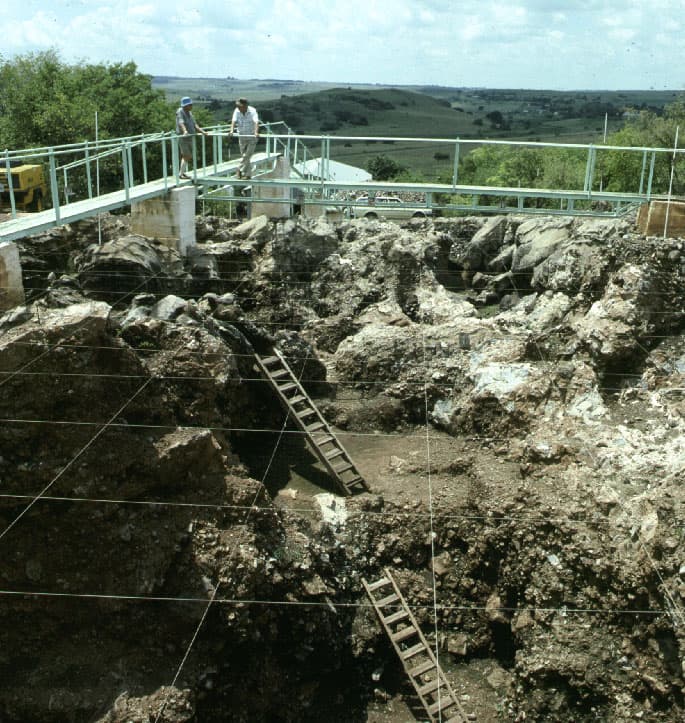
The Cradle of Humankind is a UNESCO World Heritage Site spanning approximately 47,000 hectares of dolomitic limestone landscape in Gauteng Province, South Africa, roughly 50 kilometers northwest of Johannesburg. The landscape is characterized by distinctive karstic topography — sinkholes, caves, and underground streams formed by the dissolution of limestone. The area is heavily forested with bushveld vegetation adapted to the rocky terrain.
Sterkfontein Caves, the most accessible and famous site within the Cradle, consists of a series of interconnected chambers and passages. The caves contain both fossil remains and archaeological deposits representing multiple time periods. The Maropeng Visitor Centre, opened in 2005, provides context and interpretation. The nearby Wonder Cave is open to public access, offering dramatic views of deep caverns.
The landscape itself is sacred to indigenous Khoisan peoples and to modern South Africans, representing both scientific and spiritual heritage. The rolling hills, open grasslands, and cave mouths create a landscape of profound geological and anthropological significance.
The History
The Cradle of Humankind has yielded fossils spanning from approximately 4.2 million years ago to recent historical periods. The earliest hominid fossils include Australopithecus africanus (Mrs. Ples), Paranthropus robustus, and most famously Homo naledi. The steady stream of discoveries — Mrs. Ples (1947), Paranthropus robustus (1938), Homo naledi (2015) — has made the Cradle one of the world's most important sites for understanding human evolution.
Dr. Raymond Dart, an anatomist, made the first significant discovery here in 1924 with the Taung Child (Australopithecus africanus). Robert Broom continued excavations from the 1930s-1950s, making the crucial discoveries that transformed South Africa into the center of paleoanthropological research. Modern excavations, particularly those directed by Lee Berger, have yielded Homo naledi and radically expanded understanding of human diversity in the Pleistocene.
In 2015, Lee Berger and his team discovered 1,550 fossils of Homo naledi in the Rising Star Cave, making it one of the richest single discoveries of hominin fossils. The diversity of fossil species found in close proximity suggests that multiple human species coexisted in Africa, competing and coexisting over millions of years of evolutionary history.
Frequently Asked
UNESCO World Heritage Site where humanity began — Sterkfontein Caves yielded one-third of all known human ancestor fossils including Mrs. Ples and Homo naledi.
Sources
Berger, Lee R.. Almost Human: The Astonishing Tale of Homo naledi and the Discovery That Changed Our Understanding of Human Evolution (2015). National Geographic. Account of the discovery of Homo naledi in Rising Star Cave and implications for human evolutionary history
Tier 1Dart, Raymond. Adventures with the Missing Link (1959). Harper and Brothers. Pioneering paleoanthropologist's account of early human ancestor discoveries in South Africa
Tier 2Related Entries
Pompeii
A Roman city frozen in time by the eruption of Mount Vesuvius in 79 CE — temples, houses, streets, and people preserved in volcanic ash
Campania, Italy
Skara Brae
Europe's most complete Neolithic village, with stone furniture and hearths still intact, buried under sand for 4,000 years
Orkney Islands, Scotland
L'Anse aux Meadows
The only confirmed Norse settlement in North America — proof that Vikings reached the Americas 500 years before Columbus
Newfoundland and Labrador, Canada
Chaco Canyon
Ancestral Puebloan ceremonial center with astronomical alignments, Sun Dagger sites, and a network of roads connecting outlying communities
New Mexico, United States
Mythic Grounds acknowledges that many sites documented here are sacred to Indigenous peoples and living cultural communities. We strive to present information respectfully, drawing only from published and authorized sources. If you are a member of a community represented on this site and believe any content is inaccurate or culturally inappropriate, please contact us.