 Wikimedia Commons
Aro Confederacy — 17th-19th centuriesCave / UnderworldMythology
Arochukwu Long Juju Slave RouteWest African (Ashanti / Dahomey / Igbo) Mythology
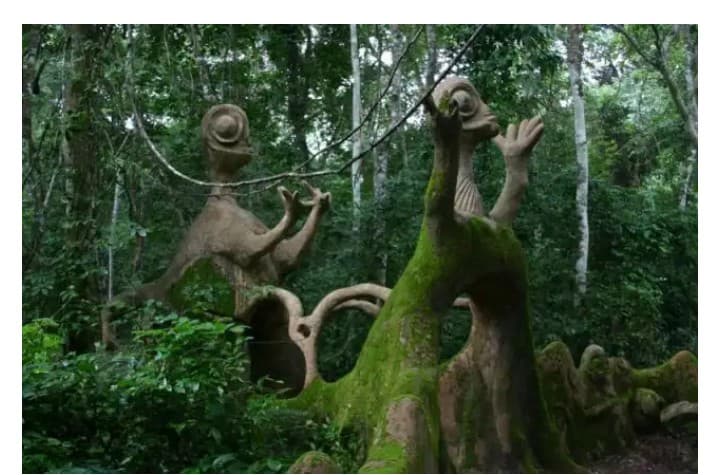
The seat of the Ibini Ukpabi oracle — the 'Long Juju' of Arochukwu, the most powerful oracle in Igboland and a feared arbiter of justice for centuries
Cultural sensitivity notice
The Arochukwu oracle site involves the traumatic history of the Atlantic slave trade. Visitors should approach with sensitivity. The Aro people have complex feelings about this history, and discussion of it should acknowledge the broader context of European demand that drove the trade.
The Myth
The Ibini Ukpabi, known to the British as the 'Long Juju,' was the most feared and revered oracle in Igboland — a divine tribunal to which disputes were brought from across southeastern Nigeria. The oracle was housed in a cave system along a stream gorge near Arochukwu, and those who went before it for judgment entered a tunnel and either emerged acquitted or 'were eaten by the god' — disappeared, their fate seemingly decided by the deity.
In Igbo cosmology, the supreme creator is Chukwu (Chi Ukwu, 'the Great God'), who is remote and delegates authority to Ala (the earth goddess, guardian of morality and fertility), and to numerous Alusi (deities associated with natural features, crafts, and human activities). The Ibini Ukpabi oracle claimed direct authority from Chukwu. Its priests, the Aro people, established a network of oracular authority across Igboland that functioned as both a judicial system and a commercial empire.
The oracle's power rested on genuine belief: communities voluntarily submitted their disputes to its judgment. Those condemned by the oracle were not executed — they were secretly sold into the Atlantic slave trade through the port of Calabar, their families told they had been consumed by the deity. This fusion of spiritual authority and commercial exploitation is one of the most documented examples of how the Atlantic slave trade co-opted existing institutions.
Want more like this?
The Weekly Myth hasn't started yet: one sacred site a week, its myth and its history. Leave your email and we'll write when the first one goes out.
We'll only use your email for the Weekly Myth. Unsubscribe anytime.
Themes
The Place
Arochukwu is a town in Abia State, southeastern Nigeria, situated on hilly terrain near the Cross River. The oracle cave complex is located in a forested gorge along a stream approximately 2 kilometers from the town center. The approach to the oracle followed a carefully staged path through dense vegetation, with sounds, lights, and theatrical effects designed to terrify supplicants.
The 'slave route' is a trail from the oracle cave through the forest to the Cross River, down which condemned individuals were marched to canoes that transported them to the slave port of Calabar. The route has been preserved as a heritage trail. The cave system itself, partially collapsed, remains a significant archaeological and cultural site. Arochukwu town contains numerous traditional Aro compounds with distinctive architecture.
The History
The Aro Confederacy, centered on Arochukwu, developed from the 17th century onward as a commercial and spiritual network connecting communities across Igboland. The Aro established colonies (Aro settlements) throughout the region, serving as traders, arbitrators, and oracular agents. Their power rested on the Ibini Ukpabi oracle's reputation for infallible judgment.
The British recognized the oracle as the central obstacle to their control of southeastern Nigeria. In 1901-1902, the Anglo-Aro War (also called the Aro Expedition) saw British forces destroy the oracle shrine and dismantle the Aro Confederacy. The discovery of the mechanism — the hidden tunnel to the river — confirmed what some had long suspected about the fate of the 'consumed.'
The Aro people today are an influential Igbo subgroup. The annual Ikeji Festival in Arochukwu celebrates Aro heritage and draws visitors from across Nigeria and the diaspora. Efforts are underway to develop the slave route and oracle site as a heritage tourism destination, similar to the slave forts of Ghana's coast.
Frequently Asked
The seat of the Long Juju — the most powerful oracle in Igboland, whose judgments secretly fed the Atlantic slave trade for over a century.
Sources
Dike, K. Onwuka and Felicia Ekejiuba. The Aro of South-eastern Nigeria, 1650-1980 (1990). University Press Limited. Comprehensive study of the Aro Confederacy and the role of the Ibini Ukpabi oracle
Tier 2Nwauwa, Apollos O.. The Aro Confederacy: State Formation, Chronology & Historiography (2023). Goldline & Jacobs Publishing (ISBN 9781938598586). View source → Nigerian historian (Bowling Green State Univ.); refines chronology and historiography of the Aro / Ibini Ukpabi system. Modern replacement for Dike & Ekejiuba 1990.
Tier 2Related Entries
Manhyia Palace & the Golden Stool
The seat of the Ashanti king and the shrine of the Golden Stool — Sika Dwa Kofi, the soul of the Ashanti nation, descended from heaven
Ashanti Region, Ghana
Royal Palaces of Abomey
The palace complex of the Dahomey kings — where Vodun priests consecrated thrones with blood, and the Amazons of Dahomey drilled in the courtyards
Zou Department, Benin
Chumash Painted Cave
A small sandstone cave in the Santa Ynez Mountains bearing Chumash rock art that may record a supernova observed in 1006 CE
California, United States
Cenote Ik Kil
A cathedral-sized sinkhole near Chichen Itza where vines fall 85 feet to turquoise water — one of the Yucatan's ancient portals to the underworld
Yucatan, Mexico
Mythic Grounds acknowledges that many sites documented here are sacred to Indigenous peoples and living cultural communities. We strive to present information respectfully, drawing only from published and authorized sources. If you are a member of a community represented on this site and believe any content is inaccurate or culturally inappropriate, please contact us.