 Wikimedia Commons
CultureIran / Central AsiaLiving tradition
Persian / Zoroastrian
The mythology of ancient Persia and Zoroastrianism — Ahura Mazda, the eternal struggle of good and evil, and the Shahnameh.
Persian mythology spans from the ancient Indo-Iranian traditions through Zoroastrianism — one of the world's oldest monotheistic religions, founded by the prophet Zarathustra (Zoroaster) perhaps as early as 1500 BCE — to the epic literary tradition culminating in Ferdowsi's Shahnameh (Book of Kings, c. 1010 CE). Zoroastrianism introduced concepts that profoundly influenced Judaism, Christianity, and Islam: the cosmic struggle between good (Ahura Mazda) and evil (Angra Mainyu), final judgment, heaven and hell, and the eventual triumph of righteousness. The Shahnameh preserves pre-Islamic Iranian mythology in poetic form — the stories of the hero Rostam, the tragic prince Sohrab, and the demonic tyrant Zahhak. Sacred fire temples, royal rock reliefs, and the ruins of Persepolis mark the Persian mythological landscape.
3 entries mapped
 Wikimedia Commons
Persian / ZoroastrianUNESCO
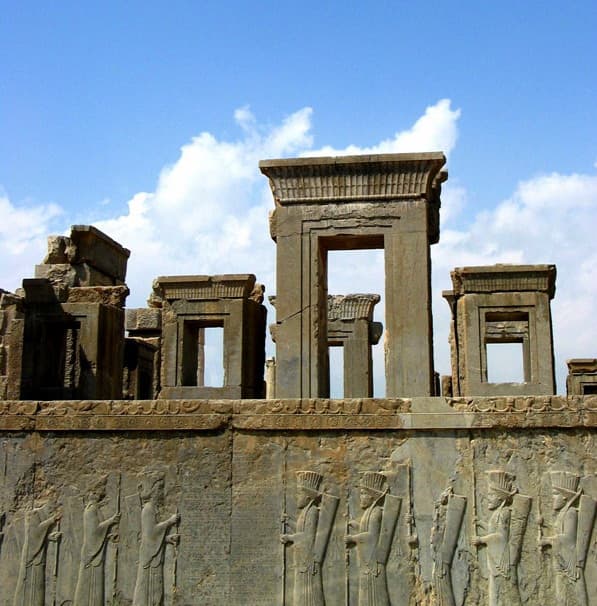
Persepolis — Throne of Jamshid
The ceremonial capital of the Achaemenid Empire — known in Persian legend as the Throne of Jamshid, the mythological king who ruled for 700 years before his fall
Shiraz, Iran (37 mi)
 Wikimedia Commons
Persian / ZoroastrianLiving traditionUNESCO
Yazd — City of Fire Temples
The desert city at the heart of Iran that has preserved Zoroastrian fire worship for over 1,500 years — where the Atash Behram burns a flame said to have been lit in 470 CE
Yazd, Iran (within city); Isfahan (190 mi); Tehran (400 mi), Iran
 Wikimedia Commons
Persian / ZoroastrianUNESCO
Takht-e Soleyman — Throne of Solomon
The volcanic crater lake and Zoroastrian fire temple complex in northwestern Iran — the most important Zoroastrian sanctuary of the Sasanian Empire, mythologized as Solomon's throne
Takab, West Azerbaijan Province (25 mi); Tabriz (150 mi), Iran